She was beginning to age gracefully and beautifully. She had crow’s feet and smile lines, whiting hair and tired bones. I loved these little things, I loved her testaments of a life well lived. A life fought for and endured with laughter in good measure.
She was brilliant, too, you know: a delighted student and longing scholar.
But she fell victim to her mind, and murdered any chance at life and redemption.
She knew what it was like to be a survivor of suicide and still chose…
We just weren’t worth living for.
Because of my brother Patrick, we used to discuss how people who want to kill themselves typically won’t tell others they struggle with suicide — voicing it can feel like limiting the option. People who admit they’re ideating can receive support and, in some ways, accountability. We assumed then that was why Patrick didn’t tell us he wanted to end his life. I know now that’s why she was dishonest about her yearning for the grave.
I’ve written it before and I’ll write it again — Secrets kill people. Shame kills people.
If you’re ideating suicide (thinking of ways to make yourself die, fixating on death, contemplating self-harm), reach out while you’re still mentally healthy enough to do so. Care enough to reach out. We want to see you grow old, even if you don’t. Don’t leave us behind, wondering why you didn’t think we were worth it to enough for you to stay around.
Your life is important. Your life is a gift. You are a gift. Please, seek professional help if you notice yourself yearning for death. Small steps and changes can transform one’s life from miserable towards healing, growth, and beauty. Don’t let pain win.
I was so eager to say goodbye to 2025. I was holding my breath until the simple man-made marker ticked to a fabricated turn of events, holding onto the hope that maybe, just maybe 2026 won’t be as awful as 2025.
Realistically, 2026 will be hard. The more time passes, the more survivors are confronted with the reality of the loss. Each new milestone permeates where the mind worked endlessly to protect itself with the beautiful art of denial. Stress/survival mode and denial guard one’s mind until he or she is safe enough to experience the most brutal emotions. Time wears away at this protection and opens one’s heart to experience caverns of pain. Thus, 2025 will be hard. More anniversaries, more milestones, more bullshit.
These man-made annual festivities beautifully prompt reflection. Trauma does a funny thing to the mind: it hijacks the brain’s memory by severely depleting the ability to store new memories and to recollect old ones. Whole weeks and months can be stolen from the traumatized mind.
This December as I reflected on my brisk 28 years, I have been irritated. I’m almost done with my twenties — a time where I’m supposed to be full of energy and life and fun and crazy — and instead I’ve spent the last decade barely surviving. I had a couple good years, 2022-2024 specifically, but other than that, my mind and body have been ravaged by trauma.
Exhaustion, high cortisol, heart arrhythmias, PCOS, barely living. Years and years of living a half-life. This year, I’m irritated about it. I’m bitter about it. I am bitter about it.
I’m so sick of living like this. I’m jealous of people that don’t have to carry this weight. I don’t want others to endure what I have, I just don’t want to carry all that I have endured. I’m agitated about stress and trauma wreaking havoc on my mind and my body, no matter how much I attempt to manage the stress.
No amount of therapy, exercise, and stress management can minimize the amount of pain other people in my life have inflicted on me. No amount of good or joyous memories can take away or replace the amount of trauma my body stores.
It’s an unending battle with so little reward. High cortisol means weight gain, no matter what I eat nor how much I exercise. Weight gain, acne, hair loss, I’m disgusting. I feel disgusting. I feel hideous and exhausted and it feels like everything I do is pointless, and nothing I do works.
So yeah, I’m bitter about it right now. I’m sad about it, I’m mad about it, and I wish I could be “over it.”
I wish I could wake up and everything would feel okay, but it’s impossible. It’s all impossible.
I have years and years of ridiculously hard work to attempt to heal and create a healthier life… and it will take years. My body won’t be healed for years, my mind won’t be healed for years, and somethings — some things will simply never heal. There are some things the mind never recovers from, and death is one of those things. The mind physically cannot comprehend death, and, thus, it never heals from those losses. The more traumatic and unexpected the loss, the less healing the brain experiences… ever.
I hate my life. I hate all of this.
AND YET, Life is a gift.
Life is a gift.
Every breath is a gift. Every moment is a gift.
Every single day is a gift. My life is a gift. My presence in your life is a gift. Others are blessed because I exist. Others are blessed simply to know me. And what is blessed? Comforted, loved, cherished, appreciated, noticed, known: Others experience all these beautiful things from me. My life is a gift, it’s a gift to you. I know my life is a gift to me, too, even when I can’t feel it. Even when all my efforts feel fruitless, even when I feel disgusting and stupid and worthless, my life is a gift.
It’s a gift to love and be loved. It’s a gift to give and receive comfort. It’s a gift to know and be known. Ir’s a gift to feel and experience life deeply. It’s a gift to live. Life is a gift.
Trauma is not a gift. Pain is not a gift. Abuse is not a gift. The bad things that have happened to you? They’re not a gift. They weren’t part of “God’s plan” and God didn’t “allow” them to build your character or make you a better person. Bad things are not good, and they will never be good. There is nothing good about murder and suicide. There is nothing good about physical and sexual abuse. There is nothing good about cruelty and depravity.
Yes, life can be beautiful after pain. Yes, pain may yield new and beautiful perspectives. These good things do not occur because of pain but rather in spite of pain.
My Dad’s life is a gift. My brothers’ lives are a gift. My husband’s life is a gift. My sister in laws’ lives are gifts. My nieces’ and nephews’ lives are a gift. My friends’ lives are gifts. These people bless — they comfort, love, cherish, appreciate, notice, know — me. Every day their lives are a gift.
Yes, I am angry and sad and bitter about what people have done to hurt me, how that has manifested in my mind and body, and the years behind and ahead of me that these traumas have stolen. Yes, I hate these major defining moments of my life, but my life is a gift. Your life is a gift to me, too. Your life is a gift to you, too. I love you 💙
Life is a gift: honor it, tend to it, cherish it. Every day. Especially on your worst days.
“Merry Christmas!” “Happy Holidays!” “Joy to the World!” We proclaim in the darkest season, with the brightest lights illuminating our obsidian neighborhoods. The most light-centric and joyous holidays amidst the coldest and darkest moments of the year — it’s a beautiful tradition. Warm hot chocolates in our hands and cozy candles on our shelves, and sorrow in many of our hearts.
Yes, firsts are hard. First Christmas without Mommy. Mommy, Mommy, Mommy. Holidays are particularly difficult because they are family-centric: extended families gather and honor traditions. Most of our siblings have kids… all my nieces and nephews have a Mommy. My husband has a Mommy, and his Momma has a Mommy too. Everyone has a Mommy… except me and my siblings. “Why don’t I get to have a Mommy?” I ask Scott, through reddened eyes. Most of us have a spouse, too, except my Daddy. She’s gone now. Holidays and family gatherings like these amplify the isolation we already feel. The void my mother left companions us always, but holidays can make it feel as though a spotlight highlights the void.
Togetherness, though, feels like medicine for this severing pain. When something like this happens to one’s family, uniting with surviving family members is like taking aleve or ibuprofen: we’re all fully aware of the gaping wound, we all still feel it, but there’s a measure of relief in each other’s company. Days leading up to the reunion pass slowly and agonizingly. We hold our breath until we can hold each other in our loving arms, united by our terribly sealed past and fighting to press on towards a healthier future.
There’s ease with this reunion. There’s a peace in shared pain, an unspoken understanding, and a space to speak about a pain only we few understand. It provides a chance to process together and to share our pain… togetherness brings healing.
This Christmas, this thought assails me: two-thousand years ago, a baby lived and died and changed the world. Six months ago, my mother died because she wanted to meet that baby. She didn’t want to wait any longer to meet her precious Jesus. These days, I often wonder if my family would have been far better off without the Church (global, not any specific church). The idolization of heaven has killed two of my family members. That’s not what Jesus wanted, I know, but our pain-saturated culture seems obsessed with this unobtainable paradise.
The point of life is not to get to heaven, and heaven is not our home… at least, not yet. Heaven may be God’s dwelling place, and it may be the land of the dead, and it may be a place of renewal and eternity, but heaven isn’t everything and it’s not the point of our existence.
Jesus came to restore the earth. Jesus came to heal the earth. Jesus didn’t come so that we would scorn and leave the earth, and Jesus didn’t come for Christians to wish their lives away hoping in heaven. On my Mom’s best days, she knew that. She taught that, she lived that.
I’m not sure if my family would have been better off without the Church, but I think dreams of heaven are dangerous to those who suffer from mental illness.
Bring heaven to earth. Bring healing to earth. Bring joy to earth. Bring peace to earth. Isn’t that why Jesus came?
It’s been six months since my mom died by suicide. Twenty-six weeks, six months.
* * * *
Six weeks after she died, the police allowed us to collect her belongings. In them, we found a deleted email that she wrote to me and my siblings. Another layer of grief, another thing to process. Some may think it should be comforting for us to know she thought about us before she died, but [to us] our mother thought about us and still chose to leave us. That stings.
We kept the letter to ourselves: it contained highly sensitive and personal information that we didn’t want shared with the world.
* * * *
Four weeks after she died, my mother’s family decided that Mom’s death was my father’s fault. My Daddy… my wonderful, wonderful daddy.
They called our church, telling them that my dad was a wicked man, sharing fraudulent stories, and slandering him. I’m not sure if the church believed them — no one reached out to me or my siblings or my father about it. I hadn’t heard from the executive church staff since a week after the funeral.
* * * *
Six weeks after she died, the police included that private deleted email in their report. I called asking for it to be redacted — it was a message my mother typed for me and my brothers, and even she decided not to send it to us… what right did the world have to the email? — but it couldn’t be redacted. Detectives said it was a clear admission of her guilt: it proved no one else was at fault, no one else was to blame.
Ironically, my mother’s family received this information, made copies of the letter and the report, and sent it out to the masses with notes blaming my father.
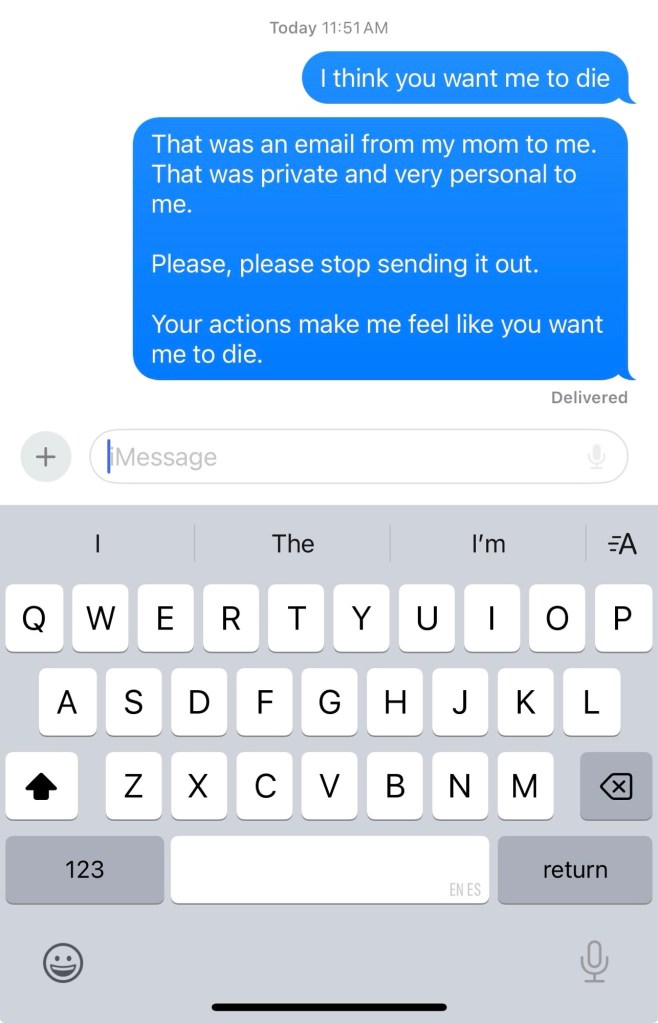
When people called us crying, saying they’re not sure why they received such information from Mom’s family and sharing their support for my Daddy, I reached out to those family members via text:
I meant it. This was entirely distressing. Another layer of grief, another hurt. It cut me to the core that they would do something like that, violating my mother’s privacy, violating my privacy, and, above all, doing something so wicked to my Daddy.
They didn’t answer the message. I haven’t heard from them since.
* * * *
Six weeks after that, I got a letter from someone on staff at the church. A kind letter, a letter filled with love, care, and memories of my mother. This was the first legitimate form of communication anyone from my family had received from an executive staff member from the church since a week after the funeral.
* * * *
One week later, we found out Mom’s family sent the police report and letters to the church. They’d been talking with the church all this time, telling staff members that my Dad and my brothers and I blamed the church for Mom’s death. The church, believing my mother’s family, chose to “take a step back” from my family because of narratives my mother’s family shared.
I spent months writing how we shouldn’t blame each other, and yet, ironically, our church thought we blamed them. How sad is that?
That same week, we had the Out of The Darkness Community Walk. Several church members came to honor my mom and my family and show their support, but I was too scared to appreciate their support at that time — it’s terrifying to go into large crowds when hate mail has been sent out about one’s family.
We hadn’t heard from the executive church staff, the people we thought we’d received the most support from… so I assumed they blamed us, I assumed they hated us, too.
* * * *
A week after that, Scott and I met the staff member who wrote that kind letter. We had dinner, we stayed for a couple hours. We cleared some of the air, I think. I think we learned from one another. It was the first time I’d seen them since a week after my Mom died — it was awkward at first, but it was kind and loving. We talked about the chaos, we talked about the fall out, we talked about missing my Mom. We talked about how the church took a step back, we talked about how they thought we blamed them.
I’m still puzzled by that: troubled that they thought we blamed them, but did not seek us out to know if we actually did.
* * * *
Last week, I met with another executive staff member. We, too, enjoyed dinner and talked about the past six months. We talked about the fear people have of reaching out to my family. Some fear the intensity, some fear the heaviness, some fear the awkwardness, some fear bombarding us.
The dinner was peaceful, healing, sweet, honest.
* * * *
Yesterday, my brother Sawyer posted alluding to these details, and, in some ways, he freed us. He freed us to tell the truth of what has happened to us. He posted it in such a tasteful way — not grotesquely, not angrily, not wickedly. He simply told the truth.
Yesterday, Scott and I went back to the church. He had been wanting to go back for a while… I couldn’t bring myself to want to go to a church where most of the executive staff hadn’t reached out to me or my family. In fact, still only those two people on the executive staff have.
It’s painful to feel abandoned by people my Mom gave so much to… her time, her life, her energy. She gave so much to the church she loved, and yes, it feels like they did abandon us.
* * * *
One of the two executive staff members that had reached out to me shared that he or she feared their “presence wouldn’t be enough” for us. The truth is, their presence was all we ever wanted.
We saw both those staff members yesterday, and I was deeply happy to see them. We smiled and we hugged and we shared how much we love each other. I love them — I love them so much. I saw another sweet friend, someone who reaches out almost on a weekly basis. They saw us and immediately came to give the warmest hug, just the hug I needed. I love them so much, too.
Presence brings healing. Togetherness brings healing. Conversations bring healing. Compassion brings healing. Eye contact brings healing. Seeing each other brings healing. Love, love brings so much healing.
I love you, Mom.
I love you, Daddy. I’m so sorry for the hurt and the injustices that have happened to you over the past six months. I’m so sorry you lost your best friend in the worst way. I’m so sorry you lost everything. You’re my hero.
I love you, Brothers. I’m so sorry you’ve had to go through these new hurts week after week. I’m so sorry we don’t have a mom.
I love you, Church staff. You’re not perfect and I don’t expect you to be, but I did expect you to be here and you weren’t. I’m sorry you lost my mom, too. I know you loved her.
I love you, Mom’s family. I hope you experience healing.
* * * *
I’m not sure what the next six weeks will look like, but I hope they’re filled with less drama than the past six months.
I hope they’re filled with healing and with renewed community. I hope relationships mend and forgiveness and trust and love grows. I hope that new life comes and new joy buds amongst the thorns of this life.
I know that I will experience a lot of pain during the next few months and years as I continue to process these numerous hurts. I know it won’t be okay, and that’s okay.
Once upon a time, there lived a relatively happy family. They were a solemn family, where sorrow was ever before their doorstep, but happiness loomed at their threshold as well.
Their smiles were bright and welcoming, their tidings were of joy and compassion. They danced among a community of happy faces, committed to the cause of goodness and grace. Though they lived many states apart, they upheld that solemn unity that family and trauma require.
The mother, yes, she was the shining star. She was the jewel of the community, welcoming the shiny happy people — celebrated for her friendliness and hospitality, honored for her good nature. A shepherd to her community, a shepherd to her family. She boasted of her beloved family — children, the apples of her eyes, and her one beloved, her friend.
But, like all beautiful things, she died.
And what of her community? This shepherd did not pastor alone. No, she had several who could have looked after her flock. Only, they didn’t.
Her family was left to grovel, abandoned by the community that celebrated their wife and mother. Shunned by those whom called her a “co-laborer in Christ” and a friend. Exiled by the very community that spoke of her love and beauty at her funeral. Her family was judged and rejected, abandoned but not forgotten.
They thought of — and prayed for, of course — her family, they said, when five or six months passed and they finally decided to check in.
Five or six months of silence, of gossip, of abandonment from the very place their wife and mother once shined. She was the woman who really “saw” people, and they couldn’t see her survivors.
I’m sick of the veiled statements and the cryptic messages: I’m disappointed and hurt by how much my mother’s pastoral staff didn’t show up for us — after all she gave to them. She gave them her life, and they repaid her by shunning her family after her death.
But, as they read this, they’ll say “See! She’s angry at us,” and not “oh, we’ve hurt her.” It’s always the sufferer who must snuff her feelings, protecting the egos of those who did the hurting. Those who inflicted pain seldom care to take ownership of their wrongs, choosing rather to call the wounded impaired.
I’m sick of the injustice of it all, I’m sick of the gossip. I’m sick of the people who got my mother’s police report, made copies of it, and mailed and/or texted it out to people who had no right to her private information. I’m sickened by the people who continue to share it, choosing not to protect my mother nor my family from harm. I’m sick of being afraid to leave my house and wonder if somebody’s going to ask me about — someone I don’t know, saying things she would never tell them, looking to exploit answers from me. I’m sick of feeling so powerless, so voiceless, against those who have hurt and who keep hurting me and my family.
There were people who blamed my mom for my brother’s death, and those same people blame my family for her death. They were vile to her, sending nasty letters and saying wicked things.
They whisper and they lie, they spread misinformation in hopes of isolating us from our community. And guess what? It worked. Shunned. Isolated. Abandoned. All in the name of Jesus.
She’s not dead in my dreams. She’s never dead in my dreams. Sometimes she’s a ghost, but she’s never really dead. She’s always responsive… or ignoring me, but nonetheless she’s active.
But they’re always about death. In the first few weeks, I most often dreamed that she was a ghost or just too busy to talk to me — in these dreams, I knew she was dead. She wouldn’t talk to me in these dreams. I begged and pleaded for her to talk with me, but I could never quite reach her.
Now, nearly six months later, we catch her before she chooses fatality. Sometimes it’s just me and Mom. Sometimes my husband, Dad, and siblings are there too. She talks to me in these dreams. I/we are always trying to talk her out of it — to talk her out of dying. To beg her to stay. But they all end the same — I wake up. I remember she’s gone and she’s never coming back. Sometimes that brings tears to my dull eyes, sometimes it cultivates anger and protest, and sometimes it steals my breath and replaces it with anxiety.
I watched Where the CrawdadsSing the day before my Mom died, and I remember feeling so comforted when the main character’s mom walks out of her life forever. It’s a main plot of the movie — trying to figure out how a mother could leave her young. I remember thinking my Mom would never.
Ha. Isn’t life ironic like that? It’s so cruel.
* * * *
This has been of the hardest weeks to do anything. To get out of bed, to go to work, to want to do anything. I’d rather turn my phone off, ditch work, and cut myself off from the rest of the world for a couple of weeks and just sleep.
Scott woke up the other night to the sound of me screaming: he reported that I was staring at our fan, shrieking. One of the strangest part about night terrors is that one won’t recall the dream whatsoever, and people experiencing night terrors won’t typically wake up on their own. They’re not very common for adults, but almost always caused by immense stress. It’s unsettling to wake up to the sound of yourself howling in horror and shaking violently.
And then you have to go to work the next day, put on your best “I’m okay” face and complete whatever task is due by whenever deadline, half alive. A shell of what once. A candle burnt to its wick, melting whatever potential was once there.
The closer we get to the Christmas, the less I want to get out of bed. But I have end of year deadlines, places to be, things to do. So we trek on, one abysmal step at a time.
* * * *
I look forward to dreams now. They’re the one place I get to interact with my Mom, even though they’re just visages from my broken heart and my weary mind. Ever so briefly, it feels like she’s with me again, even if the dream is sad and dark and heavy. At least I “saw” her, at least I could spend just a few minutes with her ghost.
Complex creatures, terribly complex creatures… Humans are terribly complex creatures. Complex, perhaps, to our own detriment, and yet perhaps complex to our own salvation, too.
We can smile while we cry, our eyes can dazzle while they feel dead inside. We can hide our true emotions phenomenally, and we can feel multitudes of emotions simultaneously. Sometimes we aren’t hiding — we simply feel two things at once: happy, sad, scared, excited, depressed, grateful, grieving.
Grateful. Grieving.
Thanksgiving.
Ah, Thanksgiving can feel antagonistic to mourners. We don’t need to be reminded of all we have to be of grateful for. We know… we simply hurt, more.
Gratefulness doesn’t erase pain, thankfulness doesn’t even ease pain. It can offer a different perspective while we suffer, but it can’t fix it.
Some things will never be fixed. Some things will always be broken. Some things will always produce pain.
Yes, I am grateful that my family gathered once more for Thanksgiving, but I’m not grateful for the absence I will forever feel during every holiday, every family gathering… everyday.
Terribly complex creatures. We smile with our eyes, we remember terrible things in our minds. We press on, we press on, we press on. We feel both, we feel nothing.
With our complexity we hide from one another. With our complexity we hide from ourselves. How terrifying detrimental this complexity may become.
My mother was like the sun, everyone felt how bright she shine. Her presence instantly lit up the room: she dazzled with light, warmth, and life everywhere she shined. Those closest to her orbited her and grew from her tender care, but they were severely scorched when our bright star transposed into a supernova. Our sun blazed and left us in ashes. What once brought warmth became an epicenter of frigidity. What once held life holds only withering dreams of what could have been. Our universe, once safe and secure, forever centers around a black hole.
* * * *
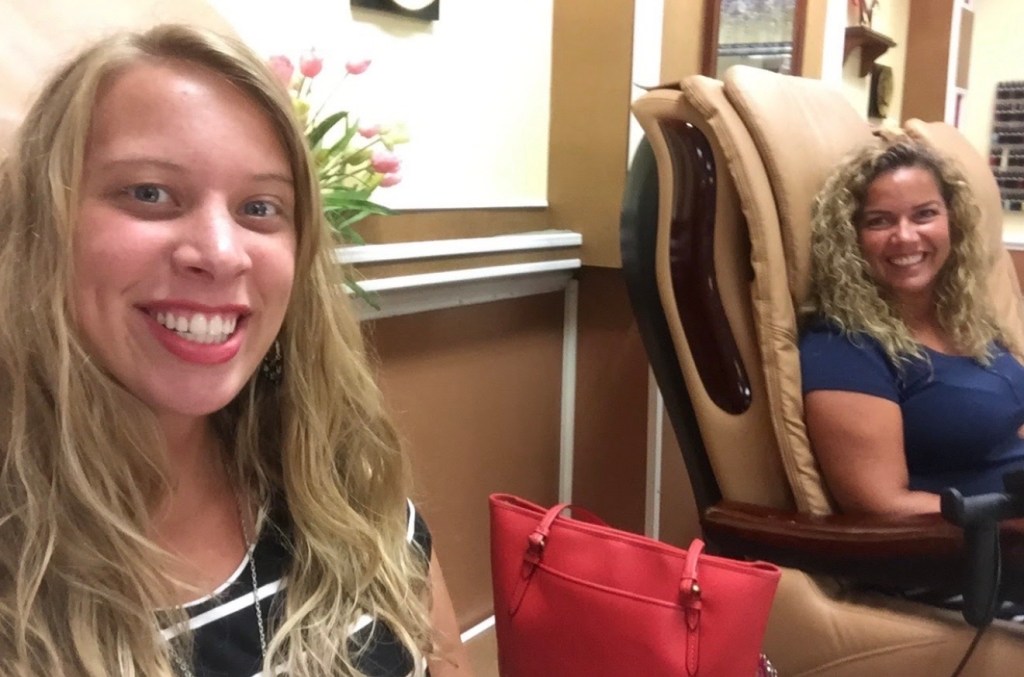
There are a few places where I feel my mother’s presence, or rather absence, most keenly. Places where memories implanted forever in my scarred mind. The spa by my home is one of these places — somewhere I can remember so well it’s almost as if she’s there. I see her in the lounge chair next to mine… only, I don’t. I see the empty chair, but her memory is so palpable I can vividly imagine her. It’s not just a spa anymore, it’s a sacred space where I once met my Mom, and where I wish so badly she was with me again.
In my mind, I imagine she’s with me. I pretend I see her smiling and welcoming me into the room, inviting me to sit with her. The sofas are so large that we sometimes shared one so we could whisper to each other. So, I imagine she’s here. I look at her empty seat and speak silently to myself “I love you, Mom. I wish you really were here with me.” I think, maybe she is. Who knows? So, I pretend she is. I carry on my empty conversation: “I love you, Mom. That’s all I want you to know.”
It’s a question my therapist often asks — “If your Mom was here, what would you want to say to her?” I cannot utter much get past “I love you, Mommy. I wish you were here.”
But today, I continue my imaginary chat. “We really were best friends. I should have told you that more often.” Maybe I did, I just can’t remember.
And I cry, and I cry, and I cry quietly to myself. Softly in the silent room of the spa, staring at an empty chair where I can’t actually see my mother. I imagine she gets out of her chair to come sit by me, I imagine she holds my hand, and I imagine she pulls me into her arms as I cry. She strokes my hair.
I imagine all of it as if it really happened. I imagine all of it alone. So quiet, so cold, so empty.
I rest my head in the gray lounge chair, as if the chair offers a hug. My imagination fades and only the simple chair remains, reminding me of my loneliness here without her.
And yet, despite the tears and heartache of that still room, it may be my favorite part of the spa because I can see her so well there.
Much has transpired over the past two weeks that will likely eternally damage my ability to trust. Losing a sibling will do that to you, losing a parent will too, and surviving suicide does that too.
As one begins to process suicide loss, the residual effects — all the drama that can occur — of surviving suicide continue to cause copious amounts of trauma.
Stigma: shame, disgrace, discredit, social unease, awkwardness, ignorance, isolation, blame.
Blame, such a nasty word. Such a damning attitude. Death is in the tongue, isn’t it?
Suicide destroyed the dead members of my family, blame destroys the living. Stigma surrounding suicide makes people awkward and afraid to broach the subject; their timidity influences survivors to believe the worst — “Maybe they aren’t reaching out because they blame us.” Maybe people don’t reach out because they think my family blames them.
How odd, how sad to blame the living for the choices of the dead.
When one survives suicide, the survivor “often feel[s] stuck in the trenches fighting a battle alone in a war they were thrown into against their will” (Kelley, 2022). The death is shamed, the survivors are shamed and can be judged for their behavior in the initial weeks of death.
She hasn’t been crying. He cried too much, he’s doing this for attention. We all know about that fight she had with the deceased, that must have contributed. Clearly their family has issues, they must be terrible. Did you see the way he looked at me? He was so rude. She didn’t answer my text message, she must not want to talk to me. Obviously her family didn’t love her. Obviously they did this to him.
Some blame in whispers, some blame in letters.
Honestly, it’s a lot harder to feel supported when people go out of their way to spread misinformation and conjectures throughout one’s community. That’s is happening to my family, that’s what is happened to me. Even with Brevard’s beautiful “Out of the Darkness” walk, the question taunted: “Are they here to support us or are they here to watch us and whisper?” I hate that I have to think that to protect myself and my family. I hate that, and I know many who love my family would hate that too.
I know people support us, but some of the people I thought would be our best supporters became our cruelest tormentors, while others became noticeably absent.
At a time when my family needs the most support, it feels impossible to know whom to trust. Too many have used information to hurt us or condemn us, too many have picked the scab around our lacerated hearts, and the blood trickles, trickles, trickles out.
Surviving suicide is a lot to process. Surviving various cruelties and disappointments after a suicide hinders that processing and brings more trauma to the survivor.
I just want to mourn my mom. How is that too much to ask?


 Exposed