Day 30

The sorrow that I dreaded has made its home in my heart, where it will forever languish.

I am so sad, forever.

Perplexing thoughts cross my mind and the minds as many as people try to make sense of this situation, but it is truly senseless. My mom’s death highlights mental illness — mentally sound people do not and cannot end their own lives. There is no reason, there is no “why,” there is nothing to blame or to conclude about this situation other than the advancement of mental illness. My mother hid it extremely well. She knew well what mental illness is, and perhaps she did not realize the depth of her own struggles until her mind was too impaired.

She didn’t do this to us, she didn’t do this at us, she didn’t do this in spite of us.

There is much we don’t know and won’t understand and to a point, it doesn’t really matter: nothing will bring her back.

My Mom’s death doesn’t forfeit her love, it doesn’t forfeit what she believed, and it doesn’t forfeit all she strived to do and who she wanted to be.

In her right mind and in her fullest, she loved life. Her laughter filled the room and bellowed from every conversation. Her smile beamed brightest around her family and with her friends. She loved getting to discover the depth of others by asking provocative questions and teasing the answers out of one another. She loved Jesus and she wanted to experience the fullness of life that God promises here on earth (John 10:10). She was passionate about mental health and desperately wanted to see others healed on this side of eternity, and I think she believed that wholly for herself, too.

Mom fought a horrific battle that she could not share with us, and while that hurts us more than anything, these facts detail a torment she kept in the shadows. If only, if only she applied her studies and reached out in the way she encouraged others to do. Maybe she spent so much time encouraging others in the hopes that she, too, would find the courage to reach out.

She wanted to make a difference, she wanted to heal. She wanted so much from this life that gave her so much. Her life was beautiful and full of laughter and love, and, in her best moments, she felt that wholly.

My mom did not die because of any one thing: she died fighting an unspeakable battle, one we’ll never know how long she fought. This painful reality scorches my heart and sometimes it feels impossible to believe that my life is good and beautiful and kind, when all feels so dark and cruel.

But I know — I know, somehow, there is grace in this. My family and I have so much life left to live, and our lives will be filled with laughter and love and goodness and opportunity that we cannot begin to imagine right now. We are blessed. We are blessed with each other, we are blessed with our outstanding community who supports and mourns with us, and we were blessed with my Mom.

My Mom was a light and a gift that I will never have again, and her absence brings tumultuous tears to my eyes each day. While this is so dark, my Mom was not all of the light in the world.

I will carry this grief with me forever, but this sadness and this grief does not dismiss the many years of joy and abundance still to come.

Grief gifts us with a new understanding of God and life and the universe. It strips us bare of any preconceived ideas rooted in anything but truth, and the fire of affliction will bring about unimaginable glory.

Right now, it’s physically impossible for us to imagine or even desire a good life when my Mom was what made our old lives so good, but we will experience blessing and healing and a new good life.

Day 22

We don’t have to be afraid of our emotions, we don’t have to be afraid of experiencing deep sadness and despair, but we should be afraid of not sharing those emotions. We should be afraid of bottling up our feelings, we should be afraid to pretend everything is okay, we should be afraid of running/hiding/escaping from our pain.

Pain demands to be felt. When we ignore it or when we hide it from the world, we destroy ourselves. It’s not fun to be sad, it doesn’t feel good, but it is vital to our health and to the health of our community.

Isolation demands secrets and keeps one quiet. Feeling one’s pain will not ruin oneself, but unshared thoughts and feelings can consume their host.

True community, sincere authenticity, and genuine friendship begin when honesty permeates every interaction. The pain that we conceal cannot stay hidden. We cannot protect our hearts from feeling deep heartbreak, but we can grow and heal from that hurt. Sharing our pain creates a system of rivers and waterways that lead to an ocean of safety — it protects from flooding and destruction that unchecked thoughts create.

Yes, enjoy privacy, yes, be discreet, yes, be careful with whom you share your inmost thoughts, but make no mistake: you must share. Be honest with yourself about your thoughts and feelings, and be open with your friends.

The only way we overcome darkness is with light — the light of honesty and truth.

Day 14

Two weeks.

There’s a weight so heavy on my chest I feel like I can barely breathe. It feels like I am operating at 50% of my normal capacity, if that. It feels so heavy. What does that even mean? Why does it legitimately feel like there is a weight pressed against my lungs, collapsing them? How does that work? How does the body do that?

I thought we had something special, me and my mom. I thought we had a great relationship. Now I feel like I didn’t even know her. Who was this woman I spent so much time with? I thought she liked being with me, I thought she wanted to be in my life, I thought she wanted to be here. But in the end, she wanted to leave me. It wasn’t worth it for her to stay in my life. She didn’t want to see me grow up anymore. I thought we were going to be two old ladies together. I thought she wanted me. I thought she wanted me. Did she think I did not love her? Why weren’t we enough?

I hate my name. I’ve hated it for a long time. My mom gave me this name because she hoped so badly for me… what good did that do for her? It’s so cruel to be named Hope when it feels like so many people in my world are hopeless.

“Hopey, you’re my Hope. You make me believe that everything’s going to be okay and that we’re really going to make it.” That’s what my brother Patrick told me two days before he ended his life. Once he died, I really started to hate my name.

Before that, I was always a pessimist. It felt so ironic to be called “hope” when I so seldom experienced hope myself.

Now this? I hate my name. It feels so cruel tonight.

Why did I start writing these? I keep asking myself that. More precisely, why did I start publishing these? I’ve loved writing for my entire life. I used to write fantastical stories, dreaming worlds late into the night when I was just a young girl. Then in puberty I started writing to cope with my ever-changing world. Now, I almost exclusively write when my emotions cloud my head, spill out of my eyes, and pours from an ink pen onto a blank page.

So, why did I start publishing these?

After Patrick died, I seriously isolated myself. I did not answer my phone for over a month and I had no desire to make contact with the outside world.

In our American culture, grief is so private. Suicide is beyond taboo, and people in mourning may be given three days of bereavement leave. Three days… how pathetic. Our culture almost treats grief like something to be ashamed of or to be quickly gotten over. Because of this, death and grief are seldom discussed and very few — especially at my ripe old age of 27 — people have much of a framework/understanding of mourning and grief.

Grief shouldn’t isolate. It should be something that pulls us all together, something that makes us stop and hold one another closer, something that prompts us to change our lives for the better.

As my friend Olivia Chancellor always says “Alone is a lie.” Maybe if I share my thoughts, others will have the courage to share theirs too. Thoughts can be scary and painful and feel so isolating, but alone is a lie. “Everything that is exposed by the light becomes visible–and everything that is illuminated becomes light,” Ephesians 5:13. It’s only when we share our darkest thoughts that we are truly able to heal from them.

I want to live. I want to have a life full of beauty and joy and pain and wonder. I want to experience it all. I want to be fully present. I want to experience life to the full in every possible way, no matter how it hurts.

I don’t want to move on from this. I will be carrying this for the rest of my life, and I want to grow and learn to carry this with grace and love and even hope. I want to live, and I want to live well.

Redemption is Coming

Now without faith it is impossible to please God, since the one who draws near to him must believe that he exists and that he rewards those who seek him.

Hebrews 11:6, CSB

I lost faith when I went through a few years of loss and turmoil.  My mind and thoughts were tormented by the harsh reality that my friend was gone, and my brother Patrick gave up his life to shame and depression.  Unable to make sense of life anymore, my faith faltered.  I was broken and in a state that felt impossible to recover from.  My reality was horror.  How can one have faith when his or her circumstances seem to contradict that which one believes? 

We each respond differently to grief and suffering; while I struggled to believe, my mother remained steadfast.  Her trust in God did not waiver despite the reality that her baby was gone, and I could not understand it.  Thus, with water-brimmed eyes in 2019, I asked her how she could remain confident, and she provided aged wisdom:

“You are so young.  I cannot imagine having to face the things that you have had to your whole life.  I have faith because I have seen the faithfulness of God over the years.  You spent the past 15 years watching destruction without redemption.  You have been so strong.”

Her words made sense – It’s challenging to maintain faith when one’s life has been painted with suffering since its beginning.   My life has been beautiful and even amidst intense suffering has been filled with mercy and blessing, but, like many, I began viewing life through lenses of sorrow as a young girl.

We are so very attached to outcomes.  We have faith that God is good, that He is the God that delivers redemption and provides healing.  Broken endings aren’t good, and they don’t look like redemption. 

It’s been four years since my brother took his life from me and I assure you, death is not good.  Mourning never ceases.  My faith was unfathomably wounded back then.  My heart turned to dust, my mind to ashes, but dust is what God used to breathe life into man. 

We died that day, each of us who loved Patrick.  Our hopes for earthly restoration disintegrated with his demise.   We were broken beyond repair, we needed entirely new perspectives and new hopes.  We had to relearn how to think, how to communicate, how to be still.

In the years following his death, I began to seek and experience the redemption my mom told me I had not yet experienced.  I felt restoration in my own life and in my own mind.  It has been beautiful because it feels like entering Spring after a harsh Winter.  It was warm and safe and filled with healing and new life. 

I have the faith I lacked those four years ago, and now I know that I can be the one to encourage fellow sufferers to hold on: you may not have had the chance to experience redemption and restoration, but you will.  You will. 

God is with us.  He is our reward. He is our comfort, our strength, and our healing.  Even when our faith falters, He brings life from loss and healing from grief. 

God is good, even when life is not, and He is good when our nightmares become reality. 

Have faith, my friends.  Your story is not over, and your life does not have to be without redemption.  Your heart can be healed.  You can have abundant life after tragedy.  Hold on, have faith, redemption is coming. 

I Write to the Griever; I Write to the Friend

Shame cloaks one in fear.  Fear keeps one in isolation.  Isolation repeats the cycle. 

It’s the tragic irony that prohibits us from knowing how to reach out to others when we need them most, and it’s often that same irony that keeps others from reaching out to us. 

The concealment of shame safely shields one from oneself and from others – at times I have been afraid to voice my concerns and share my story simply because the story itself frightened me.  Sharing makes life’s nightmares more real.  Other times, the fear of another’s someone misunderstanding has kept my fingers from typing and my mouth from speaking. 

But where does one turn when he or she internalizes those matters that are too dangerous to share with others?

I look to words – to books and to music, to poems and to plays – but what happens when there are no words?

The prevalence of centuries of literature whispers God’s mercy: one looks to the Psalms for comfort and contrition, the Old Testament stories and New Testament parables for history and application, and the prophecy books for detailed truth of who God has always been.  These precious words preserve timeless truth. It is God who bestows light and life into man, and man who reflects the image of God (Genesis 1, John 1). 

Mankind mirrors fractures of God’s mercy, not because God’s mercy is broken, but because we are broken and fallen creatures.  Mercy cracks through the brokenness of man, reflecting the glory of God, through the gift of man’s words. 

Words meant to heal, words crafted to explain, words written to comfort.  Words to bring the shamed out of isolation and into compassion: words powerful enough to help the confused and broken feel understood and validated.  

I didn’t get those words.  I couldn’t find them. 

When my world fell apart, I fell with it, and there were so few resources to explain.  No one writes about the loss of a sibling, though most of the deceased are survived by siblings.  It’s rare for young people to experience and detail loss. 

And grieving a “complicated death” (ie: suicide, murder)?  Some psychologists write to attempt to explain, but few first-hand accounts exist.  These deaths are shrouded in the shame of the survived, leaving the survived isolated, tabooed, and unreached.

I intend to share the depths of a griever’s experience as a sibling, as a friend, as a woman, as a youth, and as a survivor.  In weeks to come, I will share excerpts from my journals to convey the intensities of loss and the miracles of mercy. Some excerpts may be incredibly intense and seem hopeless, but these are the details of redemption and lament.

In the end, we’re each the griever and the friend.

So, let’s break the cycle.  Truth is not powerless. Isolation, shame, and fear are powerless.  

Yay! Now, Let’s Be Sad!

“I am attracted to the dramatic side of life, even if it is dark and painful,” Aunt Beth, laughing, reads a question from an Enneagram personality quiz. 

“No!  Who would ever mark that one??” She and a few others laugh while my eyebrows furrow and my lips instinctively respond, “Well I would.  Sorrow is so beautiful.”

— — —

I was reminded of this conversation, which took place in November of 2018, twice this week. Once from my Mom,* and then again yesterday when some coworkers and I began discussing Pixar’s Inside Out.

“Hope, which character would you be?”  To those who know me well, it’s no secret that I’m predisposed to melancholy; however, I am paradoxically an encouraging and upbeat person the majority of the time.

“Oh,” a smile dashes across my face, “I’m definitely Sadness.” 

“You?  Sadness? Why?” His cross expression detailed his surprise at my quick and seemingly unfit answer.

“Because I appreciate sorrow—that’s why I like Inside Out so much.  Yes, everyone wants to be happy.  Happiness is great, but it is sorrow that teaches us when something is wrong.  Sorrow demands a response—it makes us pause and question and reevaluate our priorities.  In a sense, sadness is the foundation of happiness.” **

— — —

We live in a society of avoiders: sorrow, pain, fear, loneliness, empty-time, noiselessness, and the like are wildly neglected emotions. Of course, no one likes these feelings, but everyone certainly experiences them. So what do we do? We’re taught to ignore our sorrow—do something that will lift your spirit. We numb the pain with alcohol and addictions. We counter loneliness with a busy schedule, fearing that we—God forbid—think and work through our issues during our spare time. For, in that spare time, we cannot avoid our feelings forever. But, when we finally have a free moment, we disassociate with music to drown out our thoughts. One nation, united in our separateness and enslaved to whatever we think takes our pain away.

Like Joy and Fear and Anger and Disgust do all that they can to keep Sadness from tainting Riley’s memories, we too do everything we can to avoid Sadness.  But what do we learn at the end of the Pixar film?  Ah yes, that we need Sadness.

Sorrow is beautiful.  She indicates our humanity.  She notifies us that a problem has entered into our lives.  She tells us that life has been better and reminds us that it should be better.  If we respect and respond to sorrow in an appropriate manner, she teaches us to hope again.

Sorrow appears with disappointment—no, we didn’t think it’d be like this.  We’re disappointed in what we’ve lost.  We set out with expectations, knowing what happiness feels like, and we were crushed by an event or a person who severed those expectations.  We lost our expectations and we lost our hopes and we lost our dreams.  Sorrow tells us that something is missing, but we cannot treat sorrow with the dignity she deserves if we simply choose to avoid her.

We have to stop teaching people that it’s bad to experience sorrow.  No one simply “gets over” disappointments.  When we teach people that they aught not be sorrowful, we’re teaching them that they need a quick solution to a deep emotional wound. 

You didn’t get over it.  You still remember the pain.  You may have healed with time and dedication, but you will not forget the sorrow you experienced along the way.

Sorrow profoundly reveals the depths of our love for one another.  When you lose someone you love—whether through death, separation, or heartbreak—you experience the fullness of love.  You experience all the intricacies of love, and it is very painful, but it teaches you to love.  It teaches you of what you have loved and it reveals to you the incredible capacity you have to love. 

My dear friend, do not squander your sorrow simply because you don’t want to feel the sadness anymore.   Can you not see the beauty of your own heart?  Can you not see that your ability to love grows yet greater?  Can you not see how beautiful that is?  How beautiful you are?

Brokenness is not a place to stay, and sorrow is not an emotion that we should become addicted to.  Like any healthy relationship, we must guard against codependency.  We cannot be over dependent on any emotion, but, rather, we must allow interdependency.  Each emotion deserves its autonomy—do not allow yourself to become trapped in an unhealthy sorrow, and yet do not refuse to feel only happiness. 

Sadness will come.  Welcome her and nurture her.  Sadness isn’t there to hurt you.  She’s appeared to help you heal, and you must heal. 

Open your eyes to the sorrow of your heart and seek God to pursue healing.  Diligently process your sorrow to understand it.  Sorrow can be scary but understanding helps to calm our fears. 

It’s okay to be sad.  It’s okay to feel all the emotions other than happiness.  We call them “negative emotions,” but, realistically, they are the emotions that teach us how to live in abundance.

— — —

Above all, love each other deeply, for love covers over a multitude of sins

I Peter 4:8

God’s love.

God loves us.

We broken people.

Lord, teach me to love like you.

I cause God sorrow again and again and again. I am toxic to him. I fail him again and again, and yet He chooses to love me.

He chose to send his Son to cover us with his love.

Listen, friend, it’s painful when someone we care about ignores or abandons or hurts us, but may we not grow cynical. May we remember to love them and may we continue to love after we’ve lost them.

May we not forget those times when we ignore God and when we fail those around us. May we always remember to love one another, for, in love, we heal and we grow from the sorrows endured.

*With Mom, the conversation went:
“Mom, I’m just sad today and I hate it,” and Mom responded “I thought you loved sorrow.”
“No, I don’t love it. I just appreciate it. It’s just so profound. Okay, you’re right. Maybe I do love it”

**Today that coworker asked me if I was “feeling better.”  Confused, I asked whether he thought I was sick, and he clarified that he was wondering if I was still sad.  His words inspired me with a soft smile and meager laugh, “Oh, I’m not sad all the time.  I just appreciate sorrow.”

For Further Reading:

Ecclesiastes 7:3

Matthew 5:1-3

John 14:1

Isaiah 53:4-6

Ephesians 4:32

Colossians 3:13

Discomposing

2019 came with vicissitudes for every aspect of my life, from a new apartment to a new job to a new haircut to a new community, and it’s been wonderful. I’m incredibly thankful for where I am, however, a pessimistic demeanor copiously subverts everything around me.

Discomposing: the days swarm past me as life becomes a conundrum. I am weary from the weight of life’s general plights, heightened through unanticipated catastrophes that stifle me as I attempt to keep going. I’ve woken up every day this week pleading: “just get up. Just make it into work. You can make it another day,” and by 10 o’clock I’m convincing myself: “just make it to lunch. If you make it to lunch, you can make it through the rest of today.”

You can make it through.

We weren’t meant to “just make it through.”  Christ said, “I came that they may have life and have it abundantly” (John 10:10).

Lately, it’s been “one thing after another,” mounting each day and piercing each night.  I should be sleeping right now.  I should be.  I wonder if life will always be like this?  After all, it has been for so long. 

“It’s not supposed to be like this,” I know.  But it is like this. “What did I do to deserve this?” I ponder restlessly.

Where is the abundance of life?  Nothing lasts forever, I know that, but this season feels unending and I am growing wearier and wearier.  Yet He is strong, and He is strong when my strength dissipates.

Everything aches.  My mind, my back, my heart. 

Father, please restore to me the joy of my salvation (Psalm 51:12).  I believe, help my unbelief (Mark 9:24).

In Loving Memory

Life is too precious.


My Grossi met Jesus March 11, 2019.  She listened to Him release the words, “Well done, Thy good and faithful servant.”  I wonder if He had tears in His eyes as He said it.  God watched Mary Ellen endure her deepest joys and most anguished sorrows.  She made it—she fought the good fight, and she finished the race with joy.  I wonder if it brought tears to His eyes.  

He had comforted her when she mourned, as He comforts we who mourn.  


I think that the hardest part about grief is knowing that you will never be able to make memories with that person again.  Death prompts you to remember all the little things that you didn’t realize you would miss.


Her smile, her laughter, her lipstick, her spunk.  Her resolution.  She was stubborn, as many of you know, and she was strong.  I admired her tenacity.  


It’s in those little moments that you grow to love someone—it’s the collection of those small moments that builds our trust and our admiration.  Those small, insignificant moments.  

And it’s often not until death that we realize the magnificence of all those moments.  


Mary Ellen Schraner built her life from a collection of moments that highlighted the importance of faith, family, and friends.  This church and these people made those moments.  You, here today, were everything to her.  She found her foundation in Christ and her blessings and joys in you.  


Nine years ago, my mother gave her a notebook entitled Grandmother, Tell Me Your Story.  Within it poses the question, “What are some of the things you hope your children and grandchildren have learned from you?”


Her answer: “Faith—the belief in God, Cooking—Hospitality,” which I know many of you inherited, and “peace in the family.”  Mary Ellen taught me those three things, and she taught me to have fun and to celebrate when life calls for celebration.  She prayed for her family more than anyone I know, she welcomed me to her home many times, and she filled my heart with joy and abundance.  


It’s strange that she’s not here with us.  It doesn’t resonate well.  My mother once said, “We are eternal beings.  We were never meant to say goodbye.”  I suppose that is why it is so devastatingly painful to miss someone who deposited memories into our own life that made us have a life worth living.


So, as we hold our breath, and as we will the world to stop spinning, let’s take the quietness of grief and utilize it as a reminder to cling to the mundane moments.  Let’s hold one another a little closer, for a little longer.  Life is far too precious and far too short to cling to anything but those who love us.  


I John 2:17 reads, “And the world is passing away along with its desires, but whoever does the will of God abides forever.”  This became one of my favorite verses the first time I endured grief from a separation that feels so very permanent, but the reality is that permanence fades when you recall Christ’s three words: “It is finished.”  


Mary Ellen was ready to meet the Savior of the world, the God that held her tears in a leger.  The God that gave her breath, and the God that took her breath away.  The God who allowed tragedy, the God who prepared and encouraged her through devastation.  The God who blessed her with so many people and things.  The God who allowed her to live a full life—she was not afraid to meet the God she knew so well and loved so dear.


I wonder if she brought tears to her Savior’s eyes—happy tears.  Christ knew that He brought her home.  The heartache and the pain of this world has left her, and she has been made alive in the fullness of Christ.  


While we cry because we miss her, I think that Christ may shed a tear in welcoming her home.

Light-Hearted

Fact: I am insecure about my writing when it’s not demanded from an overflow of desolate emotion[s].

Maybe that’s why pain beguiles me.  I don’t like pain, but, somehow, it seems to be the only thing that provides me with enough bravery to inscribe my thoughts.  Sorrow composes beauty—I’ve witnessed it create masterpieces in the lives around me, but perhaps I need to gain a similar perspective on lighter emotions.

Today, I do not write from emotions drenched in disappointment, but, rather, from an abundance of joy.

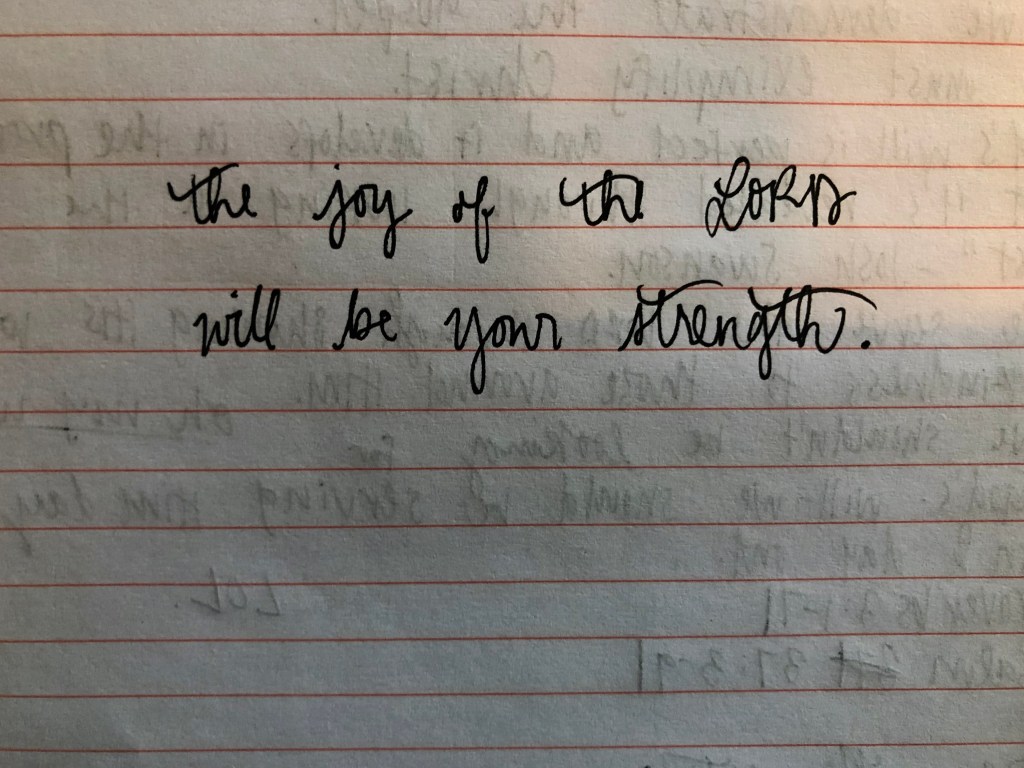
The joy of the LORD is your strength.

God carved this verse in my mind at the beginning of 2017: page after page in various notebooks were etched with the simple eight words.  I often scribbled the verse at some of my happiest moments, and thus it seemed peculiar when God reminded me of this verse.  It came in moments when I didn’t feel like I needed strength–moments when I was strong.  I was so happy, so why would God remind me of a verse that seemed more appropriate for perilous days?  

I was such a fool to think I didn’t need those words because I didn’t understand the weight of them at that time.

God allowed those joyous moments, each one meriting my trust and my strength in Him, and He reminded me at those specific times so that I would know exactly where strength proliferates when those perilous days would finally come.   

Truthfully, I couldn’t remember where those words came from… Thus, I googled the verse a couple weeks ago, and that’s when I gained a new understanding.

Then he [Nehemiah] said to them, “Go, eat of the fat, drink of the sweet, and send portions to him who has nothing prepared; for this day is holy to our Lord.  Do not be grieved, for the joy of the Lord is your strength.

Nehemiah 8:10

I was unaware of the beginning of the verse’s final sentence each time I journaled it. 

Do not be grieved,

for the joy of the Lord is your strength.

My eyes opened.  Inhale, exhale.

God engraved that verse in my mind when I was strengthened in Him to show me that He was the same God when I was crushed in spirit; He gave me that verse amidst joyous occasions so that I would know where to acquire strength when I felt despairingly weak.  He was there with me in those joyous moments, showing me His loving kindness in ways I would not comprehend until nothing else made sense. 

The timing that confused me was the exact time that God was pre-preparing to strengthen me again.  He knew how events would unfold in my life, and He knew I would need to remember His kindness when I felt that I could no longer bear my circumstances.  It’s one of the greatest paradoxes that beautifully played out in my own life: “Therefore I am well content with weakness, with insults, with distresses, with persecutions, with difficulties, for Christ’s sake; for when I am weak, then I am strong,” II Corinthians 12:10 (emphasis added).

In joy I write, remembering the sovereignty of a God who continued to remind me of His goodness when life was “good” simply to re-remind me of His goodness when life didn’t feel good. 

God reveals His strength gloriously through the depths of my humility.  I despaired, but He did not allow me to linger in anguish.   He reminds me that He is good, that yesterday and today are temporary, and that I can trust Him with tomorrow.

I received this notebook for Christmas from Victoria Romano, with the verse displayed on its back cover. Tori didn’t know what this verse had meant to me, she was just a dear friend giving a sweet gift. Behind the scenes, Christ was strengthening me through my weakness in the remembrance of this verse and those moments.  I felt unbearably weak for so long, but He renews me each day:  I feel strong again because that verse permeates my every breath.

Thank you, Lord, for doing in me what I wished would not be done, and for reviving the life I had not known was dead.