Week 26

It’s been six months since my mom died by suicide. Twenty-six weeks, six months.

* * * *

Six weeks after she died, the police allowed us to collect her belongings. In them, we found a deleted email that she wrote to me and my siblings. Another layer of grief, another thing to process. Some may think it should be comforting for us to know she thought about us before she died, but [to us] our mother thought about us and still chose to leave us. That stings.

We kept the letter to ourselves: it contained highly sensitive and personal information that we didn’t want shared with the world.

* * * *

Four weeks after she died, my mother’s family decided that Mom’s death was my father’s fault. My Daddy… my wonderful, wonderful daddy.

They called our church, telling them that my dad was a wicked man, sharing fraudulent stories, and slandering him. I’m not sure if the church believed them — no one reached out to me or my siblings or my father about it. I hadn’t heard from the executive church staff since a week after the funeral.

* * * *

Six weeks after she died, the police included that private deleted email in their report. I called asking for it to be redacted — it was a message my mother typed for me and my brothers, and even she decided not to send it to us… what right did the world have to the email? — but it couldn’t be redacted. Detectives said it was a clear admission of her guilt: it proved no one else was at fault, no one else was to blame.

Ironically, my mother’s family received this information, made copies of the letter and the report, and sent it out to the masses with notes blaming my father.

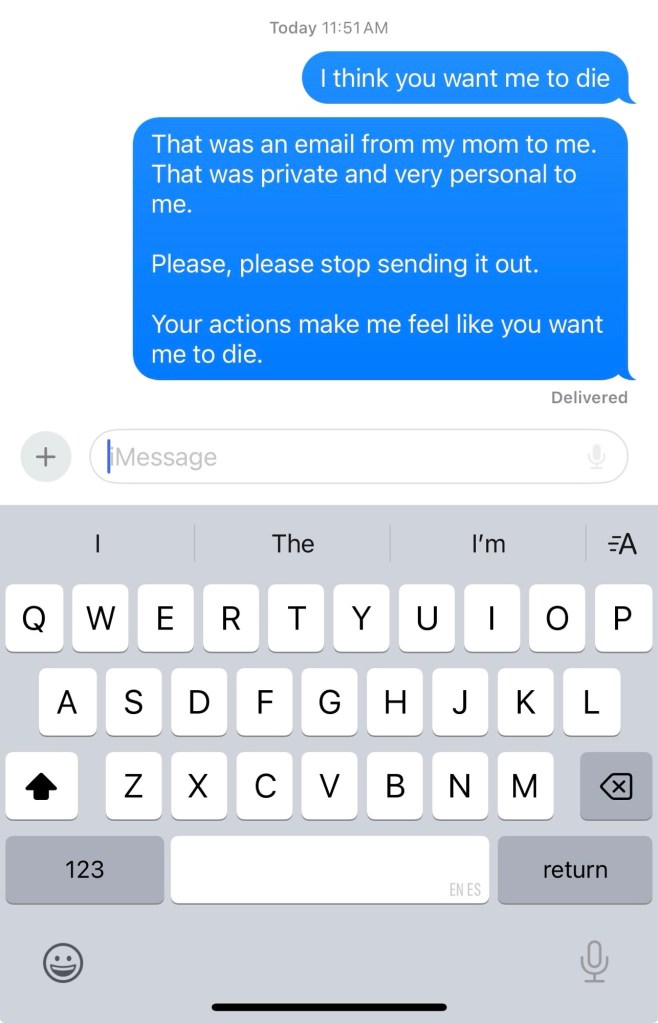
When people called us crying, saying they’re not sure why they received such information from Mom’s family and sharing their support for my Daddy, I reached out to those family members via text:

I meant it. This was entirely distressing. Another layer of grief, another hurt. It cut me to the core that they would do something like that, violating my mother’s privacy, violating my privacy, and, above all, doing something so wicked to my Daddy.

They didn’t answer the message. I haven’t heard from them since.

* * * *

Six weeks after that, I got a letter from someone on staff at the church. A kind letter, a letter filled with love, care, and memories of my mother. This was the first legitimate form of communication anyone from my family had received from an executive staff member from the church since a week after the funeral.

* * * *

One week later, we found out Mom’s family sent the police report and letters to the church. They’d been talking with the church all this time, telling staff members that my Dad and my brothers and I blamed the church for Mom’s death. The church, believing my mother’s family, chose to “take a step back” from my family because of narratives my mother’s family shared.

I spent months writing how we shouldn’t blame each other, and yet, ironically, our church thought we blamed them. How sad is that?

That same week, we had the Out of The Darkness Community Walk. Several church members came to honor my mom and my family and show their support, but I was too scared to appreciate their support at that time — it’s terrifying to go into large crowds when hate mail has been sent out about one’s family.

We hadn’t heard from the executive church staff, the people we thought we’d received the most support from… so I assumed they blamed us, I assumed they hated us, too.

* * * *

A week after that, Scott and I met the staff member who wrote that kind letter. We had dinner, we stayed for a couple hours. We cleared some of the air, I think. I think we learned from one another. It was the first time I’d seen them since a week after my Mom died — it was awkward at first, but it was kind and loving. We talked about the chaos, we talked about the fall out, we talked about missing my Mom. We talked about how the church took a step back, we talked about how they thought we blamed them.

I’m still puzzled by that: troubled that they thought we blamed them, but did not seek us out to know if we actually did.

* * * *

Last week, I met with another executive staff member. We, too, enjoyed dinner and talked about the past six months. We talked about the fear people have of reaching out to my family. Some fear the intensity, some fear the heaviness, some fear the awkwardness, some fear bombarding us.

The dinner was peaceful, healing, sweet, honest.

* * * *

Yesterday, my brother Sawyer posted alluding to these details, and, in some ways, he freed us. He freed us to tell the truth of what has happened to us. He posted it in such a tasteful way — not grotesquely, not angrily, not wickedly. He simply told the truth.

Yesterday, Scott and I went back to the church. He had been wanting to go back for a while… I couldn’t bring myself to want to go to a church where most of the executive staff hadn’t reached out to me or my family. In fact, still only those two people on the executive staff have.

It’s painful to feel abandoned by people my Mom gave so much to… her time, her life, her energy. She gave so much to the church she loved, and yes, it feels like they did abandon us.

* * * *

One of the two executive staff members that had reached out to me shared that he or she feared their “presence wouldn’t be enough” for us. The truth is, their presence was all we ever wanted.

We saw both those staff members yesterday, and I was deeply happy to see them. We smiled and we hugged and we shared how much we love each other. I love them — I love them so much. I saw another sweet friend, someone who reaches out almost on a weekly basis. They saw us and immediately came to give the warmest hug, just the hug I needed. I love them so much, too.

Presence brings healing. Togetherness brings healing. Conversations bring healing. Compassion brings healing. Eye contact brings healing. Seeing each other brings healing. Love, love brings so much healing.

I love you, Mom.

I love you, Daddy. I’m so sorry for the hurt and the injustices that have happened to you over the past six months. I’m so sorry you lost your best friend in the worst way. I’m so sorry you lost everything. You’re my hero.

I love you, Brothers. I’m so sorry you’ve had to go through these new hurts week after week. I’m so sorry we don’t have a mom.

I love you, Church staff. You’re not perfect and I don’t expect you to be, but I did expect you to be here and you weren’t. I’m sorry you lost my mom, too. I know you loved her.

I love you, Mom’s family. I hope you experience healing.

* * * *

I’m not sure what the next six weeks will look like, but I hope they’re filled with less drama than the past six months.

I hope they’re filled with healing and with renewed community. I hope relationships mend and forgiveness and trust and love grows. I hope that new life comes and new joy buds amongst the thorns of this life.

I know that I will experience a lot of pain during the next few months and years as I continue to process these numerous hurts. I know it won’t be okay, and that’s okay.

May love heal us as we pursue healing and peace 💙

Week 21

Much has transpired over the past two weeks that will likely eternally damage my ability to trust. Losing a sibling will do that to you, losing a parent will too, and surviving suicide does that too.

As one begins to process suicide loss, the residual effects — all the drama that can occur — of surviving suicide continue to cause copious amounts of trauma.

Stigma: shame, disgrace, discredit, social unease, awkwardness, ignorance, isolation, blame.

Blame, such a nasty word. Such a damning attitude. Death is in the tongue, isn’t it?

Suicide destroyed the dead members of my family, blame destroys the living. Stigma surrounding suicide makes people awkward and afraid to broach the subject; their timidity influences survivors to believe the worst — “Maybe they aren’t reaching out because they blame us.” Maybe people don’t reach out because they think my family blames them.

How odd, how sad to blame the living for the choices of the dead.

When one survives suicide, the survivor “often feel[s] stuck in the trenches fighting a battle alone in a war they were thrown into against their will” (Kelley, 2022). The death is shamed, the survivors are shamed and can be judged for their behavior in the initial weeks of death.

She hasn’t been crying. He cried too much, he’s doing this for attention. We all know about that fight she had with the deceased, that must have contributed. Clearly their family has issues, they must be terrible. Did you see the way he looked at me? He was so rude. She didn’t answer my text message, she must not want to talk to me. Obviously her family didn’t love her. Obviously they did this to him.

Some blame in whispers, some blame in letters.

Honestly, it’s a lot harder to feel supported when people go out of their way to spread misinformation and conjectures throughout one’s community. That’s is happening to my family, that’s what is happened to me. Even with Brevard’s beautiful “Out of the Darkness” walk, the question taunted: “Are they here to support us or are they here to watch us and whisper?” I hate that I have to think that to protect myself and my family. I hate that, and I know many who love my family would hate that too.

I know people support us, but some of the people I thought would be our best supporters became our cruelest tormentors, while others became noticeably absent.

At a time when my family needs the most support, it feels impossible to know whom to trust. Too many have used information to hurt us or condemn us, too many have picked the scab around our lacerated hearts, and the blood trickles, trickles, trickles out.

Surviving suicide is a lot to process. Surviving various cruelties and disappointments after a suicide hinders that processing and brings more trauma to the survivor.

I just want to mourn my mom. How is that too much to ask?

Kelley, L. (2022). Expert untangles complexities of grief for suicide loss survivors. CU Anschutz News. https://news.cuanschutz.edu/news-stories/expert-untangles-complexities-of-grief-for-suicide-loss-survivors

Week 16

Most of our wounds remain safely hidden in our own psyches. Often, we pick and choose whom we share our deepest thoughts and hurts. We choose to share with “safe,” people and find healing in that shared space of community, grace, and love. We choose not to share with people who are “not safe:” people who would misunderstand us, minimize us, or intentionally harm us with this sacred information. In this way, we manage our pain. We protect our hearts. This is safe.

Privacy is seldom discussed amongst mourning communities, and I suspect scarcely thought of by those who support survivors.

Police and media and gossip often accompany sudden, unexpected, and catastrophic deaths. At a minimum, police create reports and etch into public record details that feel so intimately private. It’s not often that our most painful experiences are published to the world.

When this happens, multitudes of “unsafe” people have what feels like limitless access into the pieces of survivors’ hearts that are still bleeding.

These unsafe people take that information and form conjectures meant to pierce the bleeding hearts of survivors. Or, maybe they’re not meant to… but they do.

People I would not choose to share this information with know the final details of my mother’s life. These facts that feel so close to me, so personal to me, so private to me, so painful to me are in the reckless hands of unsafe people. People who don’t know me well, people who don’t know my family well, and people who attempt to weaponize that information against us.

Pain and rage and mystery tend to create delusional stories in hurting peoples’ hearts. No one wants to accept this reality, so they make up their own, killing her survivors in the process.

Stigma. Once more, here it is: I think some people would have rather I died than my mother. I think some people would have rather everyone in my family died rather than my mother. I think some people still want us to die. That’s what their actions communicate, that’s what their rumors point to, and that’s where their conjectures conclude.

And then you don’t know who to trust. Who is safe? If I speak with them, will they use my words against me? Will they use my words to harm me and my family? So then I withdraw because no one feels safe anymore.

How exhausting.

I just want to mourn my mom. My mom.

It’s so messy, all of this surviving suicide.

They want us dead or perhaps they want us more injured than we already are. I’m really not sure what they want, but it only creates more suffering.

I don’t want to die. I don’t want my Dad to die. I don’t want my brothers to die. My Mom and my brother are already dead. My mom is dead.

Suicide survivors need your support: we need you to acknowledge and affirm our pain. We need to know you see us in all of our pain. So much of support is simply helping us tend to this pain and to care for ourselves when we feel as though we can barely stand.

It’s so painful when these private details are published to the world. Anyone can bring it up at any time, no matter how unsafe they may be. But that’s just the reality of loss.

I just want to mourn my mom.

I miss you, Mom.

Week 9

Traveling while grieving can become a sick game of “how many places can I be sad in?” Each new experience serves as a reminder of how I can never share any of this with my mom.

Grief mutes the senses and dulls the atmosphere. It prohibits its host from experiencing anything to the full. The infamous brain fog clouds everything one’s eyes behold and rains on the memory of one’s memory newest experiences.

Traveling is helpful, I suppose, in that it requires a massive amount of focus from one’s mind — one must keep moving, walking towards the goal of his or her next destination. One’s loss can’t be at the forefront of the mind when navigating unknown places, but the ache is there. It’s always there.

Death is such an unwelcome visitor, knocking on the doors of our lives and bursting them open despite our protests. Illnesses can creep in to poison’s one’s life, accidents can wreak havoc and destroy life, wicked people can barge in and steal life, but what is this?

What is this?

How terrifying that one’s own mind can betray itself and create death in a most unnatural way. How terrifying that we can’t even see it coming.

And then there’s the stigma: Stigma about grief, stigma about suicide, stigma about mental health, and the deep shame these stigmas create for people who struggle and for survivors left behind by those who lost the battle. Stigmas that prevent people from getting help. How can one reach out for help when everyone around them expects to have the answers?

Our church did not/has not publicly acknowledged my Mom’s death — my mom, a highly influential staff member of the church. What type of message does that send to the stigmatized? What message does that send to the thousand who attended her service and who are in deep mourning?

Maybe they don’t address it because they’re terrified of it, too. Silence always helps, doesn’t it?

Ignoring problems never makes them go away: Silence simply suffocates the suffering, and stigma shames them into solitude.

There should not be shame in “having demons.” Life is abundantly difficult and misery isn’t something to be ashamed of. There should not be shame for having a good life and still struggling with terrible intrusive thoughts. You should be safe to voice that. You should not be shamed or silenced for voicing how horrible life can be and how tormenting your own mind can be. Even God acknowledged that it was not good for man to be alone. Even Jesus acknowledged that life is troublesome. Even Jesus asked for a different way out.

I return home from a trip I aimed to keep very private — there’s a comfort in enjoying quiet and hidden moments after the world discovers something so deeply personal out about one’s life — but all I can think of is the fact that my Mom won’t be there when I get home.

She used to say that she couldn’t wait to get home after traveling because “there’s no place like Florida.” She loved its warmth and its beauty and its vibrancy. She loved that it was home, and she built her home in the loveliest ways.

I can’t reconcile how someone who loved life so much, and who loved me so much, could execute the cruelest action against all that she loved.

I wish she thought that she could get help. I’m sickened that she couldn’t verbalize her struggle. I hate the stigma, I hate the silence, I hate the finality.

If you have ever — ever — ideated, please speak out. Seek a professional counselor and share your ideations. Don’t let shame kill you. Don’t let shame destroy everything that you do love in life.

Be there when someone gets home. Be there when your friend gets home. Be there when your family gets home. Be there to welcome your loved one back. Don’t let stigma take that from all of us.