I began writing these posts to bring awareness to grief, loss, and surviving suicide.
I lost my brother to suicide when I was 21: back then, very few people in my life had experienced any type of familial loss. I lost my mother to suicide when I was 27, and, still, few people in my life have experienced familial loss.
A majority of people my age haven’t experienced loss, and a majority of people who have experienced loss have not experienced suicide.
Most people reading these posts know me and my family, and have thus now been affected by suicide.
These posts are meant to bring awareness and to highlight a community of mourners. I try to write about my individual experience with grief and it seems that many have found solace and community from these words.
A few weeks ago, I wrote how many have experienced me at my worst while I have experienced them at their best — their tenderest, their most thoughtful, their most considerate, their most generous. It has been beautiful to see people show up for me and my family.
I would be remiss not to mention how this brings out the worst in us, too. Unexpected loss makes people quick to anger or irritability as the brain tries to process a world that no longer makes sense.
Suicide loss forces people to try to find meaning behind a senseless and terrible loss, and this can turn people against one another in the vilest ways. Endless questions of Why did she end her life? exhaust survivors’ minds and, too quickly, the community that should rally to support one another the most instead turns on each other.
In trying to find meaning, survivors can all too easily blame one another — It must have been her job stress. It must have been the church. It must have been her family. It must have been her parents’. It must have been her kids. It must have been her spouse. It must have been her sibling. It must have been her friends. It must have been myself. You should have seen the signs. I should have seen the signs.
Do you see how damning those statements are?
Damning.
Those statements destroy, and, yet, those who should support one another the most can viscously accuse one another with similar statements.
People think it. Some people say it. All survivors feel it.
The truth is that all of this is horrific. The truth is that no one on the planet wanted this. The truth is that any of us would have done anything to prevent this outcome. And yet, people still whisper accusations about survivors and can scream them at her closest friends and family members.
Nobody wanted this. Nobody caused this. Don’t blame her community. Don’t blame her friends. Don’t blame her family. Don’t blame yourself.
Don’t add more hurt to the most painful situation imaginable.
The sorrow that I dreaded has made its home in my heart, where it will forever languish.
I am so sad, forever.
Perplexing thoughts cross my mind and the minds as many as people try to make sense of this situation, but it is truly senseless. My mom’s death highlights mental illness — mentally sound people do not and cannot end their own lives. There is no reason, there is no “why,” there is nothing to blame or to conclude about this situation other than the advancement of mental illness. My mother hid it extremely well. She knew well what mental illness is, and perhaps she did not realize the depth of her own struggles until her mind was too impaired.
She didn’t do this to us, she didn’t do this at us, she didn’t do this in spite of us.
There is much we don’t know and won’t understand and to a point, it doesn’t really matter: nothing will bring her back.
My Mom’s death doesn’t forfeit her love, it doesn’t forfeit what she believed, and it doesn’t forfeit all she strived to do and who she wanted to be.
In her right mind and in her fullest, she loved life. Her laughter filled the room and bellowed from every conversation. Her smile beamed brightest around her family and with her friends. She loved getting to discover the depth of others by asking provocative questions and teasing the answers out of one another. She loved Jesus and she wanted to experience the fullness of life that God promises here on earth (John 10:10). She was passionate about mental health and desperately wanted to see others healed on this side of eternity, and I think she believed that wholly for herself, too.
Mom fought a horrific battle that she could not share with us, and while that hurts us more than anything, these facts detail a torment she kept in the shadows. If only, if only she applied her studies and reached out in the way she encouraged others to do. Maybe she spent so much time encouraging others in the hopes that she, too, would find the courage to reach out.
She wanted to make a difference, she wanted to heal. She wanted so much from this life that gave her so much. Her life was beautiful and full of laughter and love, and, in her best moments, she felt that wholly.
My mom did not die because of any one thing: she died fighting an unspeakable battle, one we’ll never know how long she fought. This painful reality scorches my heart and sometimes it feels impossible to believe that my life is good and beautiful and kind, when all feels so dark and cruel.
But I know — I know, somehow, there is grace in this. My family and I have so much life left to live, and our lives will be filled with laughter and love and goodness and opportunity that we cannot begin to imagine right now. We are blessed. We are blessed with each other, we are blessed with our outstanding community who supports and mourns with us, and we were blessed with my Mom.
My Mom was a light and a gift that I will never have again, and her absence brings tumultuous tears to my eyes each day. While this is so dark, my Mom was not all of the light in the world.
I will carry this grief with me forever, but this sadness and this grief does not dismiss the many years of joy and abundance still to come.
Grief gifts us with a new understanding of God and life and the universe. It strips us bare of any preconceived ideas rooted in anything but truth, and the fire of affliction will bring about unimaginable glory.
Right now, it’s physically impossible for us to imagine or even desire a good life when my Mom was what made our old lives so good, but we will experience blessing and healing and a new good life.
Losing a parent feels like losing one’s foundation.
Losing a parent to suicide feels like finding out one’s entire life was a lie.
Distraught – that has been the word most on my mind today.
Suicide makes one relive and rethink every interaction with the lost loved one, and, today, it’s made me angry. I’m angry my Mom is gone. I’m envious of everyone who gets to have a mom. I see a mother loving her young children, and I think of my mother and how much I know she loved me and our family. But I see a mom with her young children and can’t help but think how could you [Mom] do this to me?
How could she be so hopeless? She truly had so many things she loved, looked forward to, and enjoyed about life. She never uttered a word about hopelessness, but it was there. Maybe it was always there.
Maybe every day for the past 51 years was a blessing, maybe every day was one more day than she thought possible. Who knows? We’ll never know, so it almost doesn’t even matter.
I am distraught. I am distraught that my mother had these thoughts. I am distraught that she couldn’t think of all the beautiful things she had to live for in her last day on earth. I’m distraught because, as hopeless as she clearly was, she did have so much that she loved and so much that she did look forward to.
I am distraught because I am angry with my mother for choosing this. I am angry at God for allowing it — which is likely bad theology, honestly. God gave man the power to choose, and my mother chose poorly on that day. I am distraught because I have to have all of these thoughts and think through all of these things. I am distraught because every day feels like I’m learning something tragic I didn’t know — as if my life hadn’t had enough tragedy in it already.
Thanks, Mom.
I am distraught because I loved my mom. I loved her so much, and any of us would have done anything for her. I am distraught because she hurt immeasurably bad and there is nothing I can ever do about that, ever. I am distraught because I will carry this cross with me for the rest of my life.
I am distraught because I know that God is good, and that God will bring good and beautiful things into my life — things I will never get to share with my mother, whom I loved so much.
I am distraught because I have to watch my Dad and brothers not have a wife and a mother. I am distraught because I have to watch my husband and my in-laws not have their mother in law. I am distraught because I have to watch her friends not have their friend. My beautiful Momma.
I am distraught because she did this. I am distraught because, in her mind, she had to do this. I am distraught that people’s minds can do that to them.
I am distraught that little things in my house get messy — my bathtub needs cleaned, my library has books and pens that I don’t know what to do with because I’m still using them and still reading them.
I am proud. I am proud that I am brushing my hair every day. I am proud that I am getting up every day. I am proud that I am leaving the house every day. I am proud that Dad and I are going on bike rides every day. I am proud that I am eating every day. I am proud that I am showering [almost] every day — sometimes I don’t remember if I have or haven’t showered, but I know I’m brushing my hair and teeth each day. I am proud that I am exercising every day. I am proud that I am going to therapy. I am proud that I am doing the bare minimum to at least be physically okay. I am proud that I started reading my Bible each day. I am proud that I am letting people help and support me. I am proud of a lot, and I am thankful for a lot.
Parents really are foundational. I feel like a house whose foundation has cracked in half. Restore me, Lord, for I my foundation crumbled.
I have enough without my mom. My life is still good without my mom, but, God, I wish I had my mom to share my life with.
We don’t have to be afraid of our emotions, we don’t have to be afraid of experiencing deep sadness and despair, but we should be afraid of not sharing those emotions. We should be afraid of bottling up our feelings, we should be afraid to pretend everything is okay, we should be afraid of running/hiding/escaping from our pain.
Pain demands to be felt. When we ignore it or when we hide it from the world, we destroy ourselves. It’s not fun to be sad, it doesn’t feel good, but it is vital to our health and to the health of our community.
Isolation demands secrets and keeps one quiet. Feeling one’s pain will not ruin oneself, but unshared thoughts and feelings can consume their host.
True community, sincere authenticity, and genuine friendship begin when honesty permeates every interaction. The pain that we conceal cannot stay hidden. We cannot protect our hearts from feeling deep heartbreak, but we can grow and heal from that hurt. Sharing our pain creates a system of rivers and waterways that lead to an ocean of safety — it protects from flooding and destruction that unchecked thoughts create.
Yes, enjoy privacy, yes, be discreet, yes, be careful with whom you share your inmost thoughts, but make no mistake: you must share. Be honest with yourself about your thoughts and feelings, and be open with your friends.
The only way we overcome darkness is with light — the light of honesty and truth.
I’m not really sure what to type today, but I set out to write and publish 30 days of thoughts to give people a glimpse into the world of a survivor.
“Suicide,” “murder,” “survivor” — these are all words I never thought would be so incredibly personal and defining in my life. I remember the first time I really learned in-depth about suicide the was in an eighth or ninth grade English class, studying Thirteen Reasons Why. I didn’t care much for the book then… I detest it even more now. I had no idea, back then, that suicide would claim as least a third of my family.
It’s so dark, so horrific. I observe that most shy away from the topic. Families have been shamed, judgement often cast at survivors. Survivors — what a heavy title. Institutions often choose not to address it corporately. I assume so few understand the depth of the concept, and people often flounder when they are unfamiliar with something so dark, so scary, and so sensitive.
The band Twenty One Pilots engages in the conversation. Their song “Neon Gravestones,” discusses how culture has glorified suicide, stating it’s “further engraving an earlier grave is an optional way.” Contrasting the idealized perspective, the band ends the song with the following lyrics:
Find your grandparents or someone of age Pay some respects for the path that they paved To life they were dedicated Now, that should be celebrated!
The beginning of the song highlights a dangerous mindset:
“Keep your wits about you while you got ’em ‘Cause your wits are first to go while you’re problem-solving”
This is a dark post, but I do want to bring awareness to this epidemic.
For those who are struggling, ending your life does not solve the problem. Your pain and your hurt are real. It may feel absolutely impossible, but you can heal. Your life can be redeemed. This pain, it will be redeemed.
One day, I will run out of pictures of me and Mom. That thought haunts me every time I write one of these posts.
I feel bad for the kids who will grow up with ChatGBT, for they may never know the therapeutic art of writing.
“From the fruit of a person’s mouth his stomach is satisfied; he is filled with the product of his lips. Death and life are in the power of the tongue, and those who love it will eat its fruit. ”
Proverbs 18:20-21, CSB
I’ve thought a lot about words recently: which words lead to life and which lead to death. Words are incredibly powerful. With a mere sentence, one can build up and encourage or one can destroy hope.
One of the first few phrases I uttered after I found out about my Mom’s death was “I can’t do this. I can’t lose my Mom. Scott, I can’t lose my Mom. I can’t lose my Momma. Not my Momma,” I voiced in horror as the concept became a reality.
I’ve thought about that a lot: “I can’t do this,” but the truth is, I can. I don’t want to and I wish more than anything in the world that it wasn’t true, but I can do it. Then, I thought about how the phrases “I can’t do this” and “I can’t handle this,” are statements that lead to death. They’re dangerous – voicing and thinking them concedes defeat before endurance begins.
Thus, I am working to eliminate them from my vocabulary. I can handle this, I can do this, and you can, too.
Life and death are in the tongue, but the tongue only voices what the mind first conceptualized. We must retrain our minds to prepare for the trials we endure.
You and I — we can do this. We are going to make it. We can do this together, we must do this together. Isolation, avoidance, and silence destroy us. Together, we can share our burdens, we can support one another, and we can learn to love and to grow amidst what feels like a nightmare.
I wish my Momma would have chosen together. I wish she would have shared. If she were in her right mind, I believe she would have. We honor her when we share our burdens — it’s what she wanted for and from all of us.
She didn’t want this, not really. She spent the last few years of her life dedicated to preventing this type of reality. That was real. Her passion was real. Her detest for this type of pain was real, but, on that abhorrent day, she believed she couldn’t handle it, and she made that decision alone.
You can handle it. I can handle it. We can handle it together 💙. In her right mind, that is what she would have wanted.
“I am attracted to the dramatic
side of life, even if it is dark and painful,” Aunt Beth, laughing, reads a
question from an Enneagram personality quiz.
“No! Who would ever mark that one??” She and a few others laugh while my eyebrows furrow and my lips instinctively respond, “Well I would. Sorrow is so beautiful.”
— — —
I was reminded of this conversation, which took place in November of 2018, twice this week. Once from my Mom,* and then again yesterday when some coworkers and I began discussing Pixar’s Inside Out.
“Hope, which character would you
be?” To those who know me well, it’s no
secret that I’m predisposed to melancholy; however, I am paradoxically an
encouraging and upbeat person the majority of the time.
“Oh,” a smile dashes across my
face, “I’m definitely Sadness.”
“You? Sadness? Why?” His cross expression detailed
his surprise at my quick and seemingly unfit answer.
“Because I appreciate sorrow—that’s why I like Inside Out so much. Yes, everyone wants to be happy. Happiness is great, but it is sorrow that teaches us when something is wrong. Sorrow demands a response—it makes us pause and question and reevaluate our priorities. In a sense, sadness is the foundation of happiness.” **
— — —
We live in a society of avoiders: sorrow, pain, fear, loneliness, empty-time, noiselessness, and the like are wildly neglected emotions. Of course, no one likes these feelings, but everyone certainly experiences them. So what do we do? We’re taught to ignore our sorrow—do something that will lift your spirit. We numb the pain with alcohol and addictions. We counter loneliness with a busy schedule, fearing that we—God forbid—think and work through our issues during our spare time. For, in that spare time, we cannot avoid our feelings forever. But, when we finally have a free moment, we disassociate with music to drown out our thoughts. One nation, united in our separateness and enslaved to whatever we think takes our pain away.
Like Joy and Fear and Anger and
Disgust do all that they can to keep Sadness from tainting Riley’s memories, we
too do everything we can to avoid Sadness.
But what do we learn at the end of the Pixar film? Ah yes, that we need Sadness.
Sorrow is beautiful. She indicates our humanity. She notifies us that a problem has entered into our lives. She tells us that life has been better and reminds us that it should be better. If we respect and respond to sorrow in an appropriate manner, she teaches us to hope again.
Sorrow appears with
disappointment—no, we didn’t think it’d be like this. We’re disappointed in what we’ve lost. We set out with expectations, knowing what
happiness feels like, and we were crushed by an event or a person who severed
those expectations. We lost our expectations
and we lost our hopes and we lost our dreams.
Sorrow tells us that something is missing, but we cannot treat sorrow
with the dignity she deserves if we simply choose to avoid her.
We have to stop teaching people
that it’s bad to experience sorrow. No
one simply “gets over” disappointments.
When we teach people that they aught not be sorrowful, we’re teaching them
that they need a quick solution to a deep emotional wound.
You didn’t get over it. You still remember the pain. You may have healed with time and dedication,
but you will not forget the sorrow you experienced along the way.
Sorrow profoundly reveals the
depths of our love for one another. When
you lose someone you love—whether through death, separation, or heartbreak—you experience
the fullness of love. You experience all
the intricacies of love, and it is very painful, but it teaches you to
love. It teaches you of what you have
loved and it reveals to you the incredible capacity you have to love.
My dear friend, do not squander your sorrow simply because you don’t want to feel the sadness anymore. Can you not see the beauty of your own heart? Can you not see that your ability to love grows yet greater? Can you not see how beautiful that is? How beautiful you are?
Brokenness is not a place to stay,
and sorrow is not an emotion that we should become addicted to. Like any healthy relationship, we must guard
against codependency. We cannot be over dependent
on any emotion, but, rather, we must allow interdependency. Each emotion deserves its autonomy—do not
allow yourself to become trapped in an unhealthy sorrow, and yet do not refuse
to feel only happiness.
Sadness will come. Welcome her and nurture her. Sadness isn’t there to hurt you. She’s appeared to help you heal, and you must
heal.
Open your eyes to the sorrow of your heart and seek God to pursue healing. Diligently process your sorrow to understand it. Sorrow can be scary but understanding helps to calm our fears.
It’s okay to be sad. It’s okay to feel all the emotions other than happiness. We call them “negative emotions,” but, realistically, they are the emotions that teach us how to live in abundance.
— — —
Above all, love each other deeply, for love covers over a multitude of sins
I Peter 4:8
God’s love.
God loves us.
We broken people.
Lord, teach me to love like you.
I cause God sorrow again and again and again. I am toxic to him. I fail him again and again, and yet He chooses to love me.
He chose to send his Son to cover us with his love.
Listen, friend, it’s painful when someone we care about ignores or abandons or hurts us, but may we not grow cynical. May we remember to love them and may we continue to love after we’ve lost them.
May we not forget those times when we ignore God and when we fail those around us. May we always remember to love one another, for, in love, we heal and we grow from the sorrows endured.
*With Mom, the conversation went: “Mom, I’m just sad today and I hate it,” and Mom responded “I thought you loved sorrow.” “No, I don’t love it. I just appreciate it. It’s just so profound. Okay, you’re right. Maybe I do love it”
**Today that coworker asked me if I was “feeling better.” Confused, I asked whether he thought I was sick, and he clarified that he was wondering if I was still sad. His words inspired me with a soft smile and meager laugh, “Oh, I’m not sad all the time. I just appreciate sorrow.”
2019 came with vicissitudes for every aspect of my life, from a new apartment to a new job to a new haircut to a new community, and it’s been wonderful. I’m incredibly thankful for where I am, however, a pessimistic demeanor copiously subverts everything around me.
Discomposing: the days swarm past me as life becomes a conundrum. I am weary from the weight of life’s general plights, heightened through unanticipated catastrophes that stifle me as I attempt to keep going. I’ve woken up every day this week pleading: “just get up. Just make it into work. You can make it another day,” and by 10 o’clock I’m convincing myself: “just make it to lunch. If you make it to lunch, you can make it through the rest of today.”
You can make it through.
We weren’t meant to “just make it through.” Christ said, “I came that they may have life
and have it abundantly” (John 10:10).
Lately, it’s been “one thing after another,” mounting each day and piercing each night. I should be sleeping right now. I should be. I wonder if life will always be like this? After all, it has been for so long.
“It’s not supposed to be like this,” I know. But it is like this. “What did I do to deserve this?” I ponder restlessly.
Where is the abundance of
life? Nothing lasts forever, I know
that, but this season feels unending and I am growing wearier and wearier. Yet He is strong, and He is strong when my
strength dissipates.
Everything aches. My mind, my back, my heart.
Father, please restore to me the
joy of my salvation (Psalm 51:12). I
believe, help my unbelief (Mark 9:24).
Fact: I am insecure about my writing when it’s not demanded from
an overflow of desolate emotion[s].
Maybe that’s why pain beguiles me. I don’t like
pain, but, somehow, it seems to be the only thing that provides me with enough bravery
to inscribe my thoughts. Sorrow composes
beauty—I’ve witnessed it create masterpieces in the lives around me, but
perhaps I need to gain a similar perspective on lighter emotions.
Today, I do not write from emotions drenched in
disappointment, but, rather, from an abundance of joy.
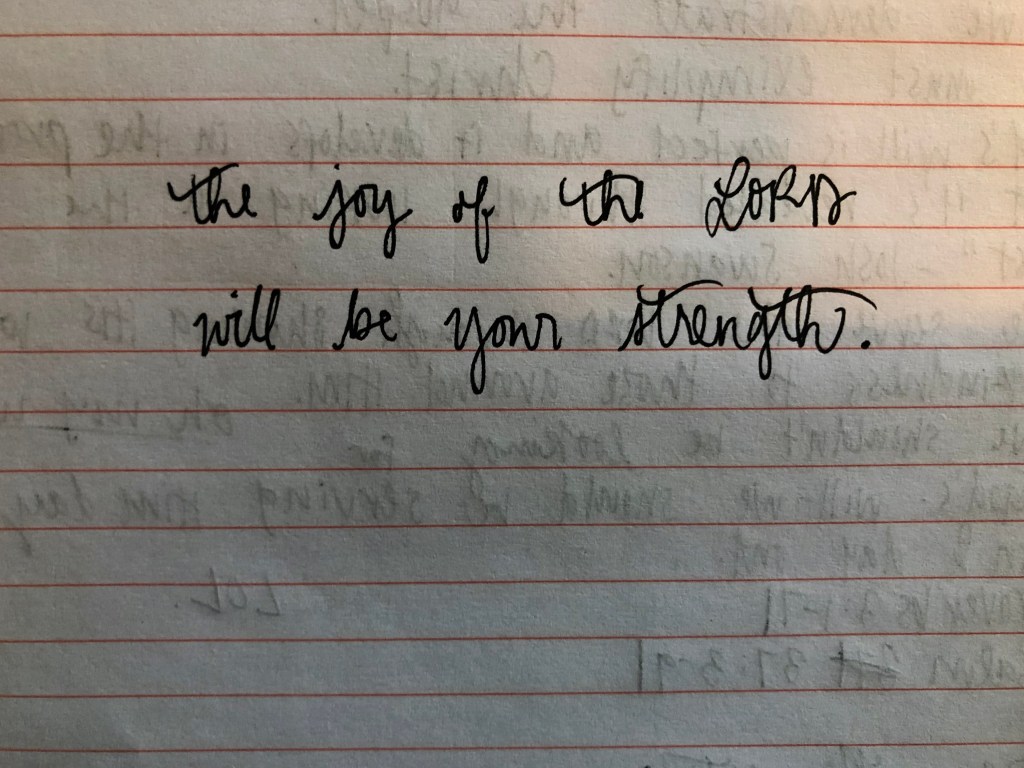
The joy of the LORD is your
strength.
God carved this verse in my mind at the beginning of 2017: page after page in various notebooks were etched with the simple eight words. I often scribbled the verse at some of my happiest moments, and thus it seemed peculiar when God reminded me of this verse. It came in moments when I didn’t feel like I needed strength–moments when I was strong. I was so happy, so why would God remind me of a verse that seemed more appropriate for perilous days?
I was such a fool to think I didn’t need those words because
I didn’t understand the weight of them at that time.
God allowed those joyous moments, each one meriting my trust and my strength in Him, and He reminded me at those specific times so that I would know exactly where strength proliferates when those perilous days would finally come.
Truthfully, I couldn’t remember where those words came from…
Thus, I googled the verse a couple weeks ago, and that’s when I gained a new understanding.
Then he [Nehemiah] said to them,
“Go, eat of the fat, drink of the sweet, and send portions to him who has nothing
prepared; for this day is holy to our Lord. Do not be grieved, for the
joy of the Lord is your strength.
Nehemiah 8:10
I was unaware of the beginning of
the verse’s final sentence each time I journaled it.
Do not be grieved,
for the joy of the Lord is your strength.
My eyes opened. Inhale, exhale.
God engraved that verse in my mind when I was strengthened in Him to show me that He was the same God when I was crushed in spirit; He gave me that verse amidst joyous occasions so that I would know where to acquire strength when I felt despairingly weak. He was there with me in those joyous moments, showing me His loving kindness in ways I would not comprehend until nothing else made sense.
The timing that confused me was the exact time that God was pre-preparing to strengthen me again. He knew how events would unfold in my life, and He knew I would need to remember His kindness when I felt that I could no longer bear my circumstances. It’s one of the greatest paradoxes that beautifully played out in my own life: “Therefore I am well content with weakness, with insults, with distresses, with persecutions, with difficulties, for Christ’s sake; for when I am weak, then I am strong,” II Corinthians 12:10 (emphasis added).
In joy I write, remembering the sovereignty of a God who continued to remind me of His goodness when life was “good” simply to re-remind me of His goodness when life didn’t feel good.
God reveals His strength gloriously through the depths of my humility. I despaired, but He did not allow me to linger in anguish. He reminds me that He is good, that yesterday and today are temporary, and that I can trust Him with tomorrow.
I received this notebook for Christmas from Victoria Romano, with the verse displayed on its back cover. Tori didn’t know what this verse had meant to me, she was just a dear friend giving a sweet gift. Behind the scenes, Christ was strengthening me through my weakness in the remembrance of this verse and those moments. I felt unbearably weak for so long, but He renews me each day: I feel strong again because that verse permeates my every breath.
Thank you, Lord, for doing in me what I wished would not be done, and for reviving the life I had not known was dead.








 Exposed