Week 26

It’s been six months since my mom died by suicide. Twenty-six weeks, six months.

* * * *

Six weeks after she died, the police allowed us to collect her belongings. In them, we found a deleted email that she wrote to me and my siblings. Another layer of grief, another thing to process. Some may think it should be comforting for us to know she thought about us before she died, but [to us] our mother thought about us and still chose to leave us. That stings.

We kept the letter to ourselves: it contained highly sensitive and personal information that we didn’t want shared with the world.

* * * *

Four weeks after she died, my mother’s family decided that Mom’s death was my father’s fault. My Daddy… my wonderful, wonderful daddy.

They called our church, telling them that my dad was a wicked man, sharing fraudulent stories, and slandering him. I’m not sure if the church believed them — no one reached out to me or my siblings or my father about it. I hadn’t heard from the executive church staff since a week after the funeral.

* * * *

Six weeks after she died, the police included that private deleted email in their report. I called asking for it to be redacted — it was a message my mother typed for me and my brothers, and even she decided not to send it to us… what right did the world have to the email? — but it couldn’t be redacted. Detectives said it was a clear admission of her guilt: it proved no one else was at fault, no one else was to blame.

Ironically, my mother’s family received this information, made copies of the letter and the report, and sent it out to the masses with notes blaming my father.

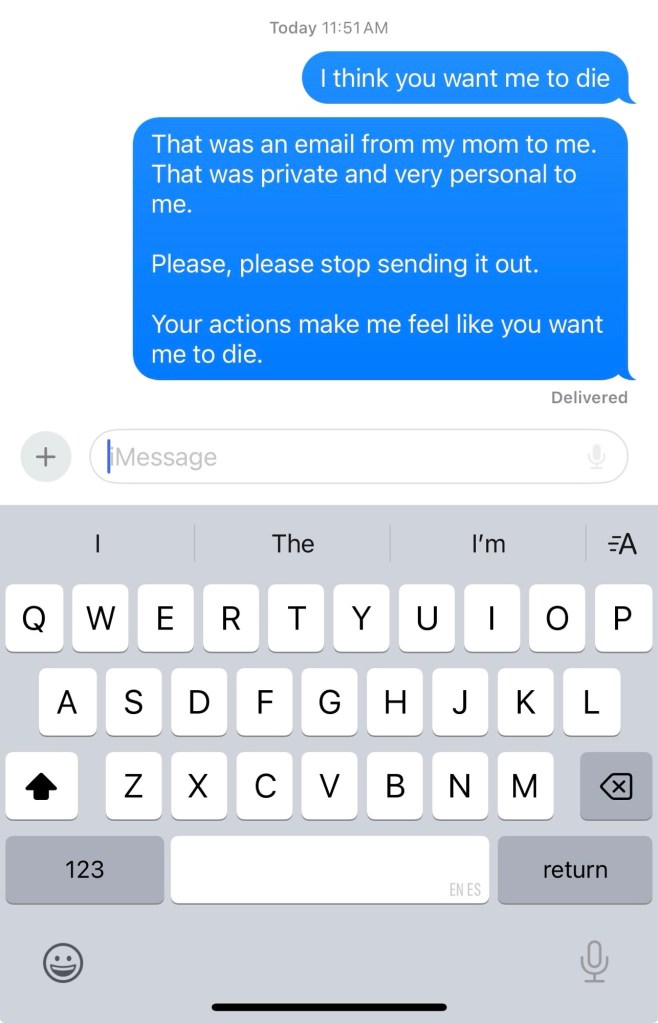
When people called us crying, saying they’re not sure why they received such information from Mom’s family and sharing their support for my Daddy, I reached out to those family members via text:

I meant it. This was entirely distressing. Another layer of grief, another hurt. It cut me to the core that they would do something like that, violating my mother’s privacy, violating my privacy, and, above all, doing something so wicked to my Daddy.

They didn’t answer the message. I haven’t heard from them since.

* * * *

Six weeks after that, I got a letter from someone on staff at the church. A kind letter, a letter filled with love, care, and memories of my mother. This was the first legitimate form of communication anyone from my family had received from an executive staff member from the church since a week after the funeral.

* * * *

One week later, we found out Mom’s family sent the police report and letters to the church. They’d been talking with the church all this time, telling staff members that my Dad and my brothers and I blamed the church for Mom’s death. The church, believing my mother’s family, chose to “take a step back” from my family because of narratives my mother’s family shared.

I spent months writing how we shouldn’t blame each other, and yet, ironically, our church thought we blamed them. How sad is that?

That same week, we had the Out of The Darkness Community Walk. Several church members came to honor my mom and my family and show their support, but I was too scared to appreciate their support at that time — it’s terrifying to go into large crowds when hate mail has been sent out about one’s family.

We hadn’t heard from the executive church staff, the people we thought we’d received the most support from… so I assumed they blamed us, I assumed they hated us, too.

* * * *

A week after that, Scott and I met the staff member who wrote that kind letter. We had dinner, we stayed for a couple hours. We cleared some of the air, I think. I think we learned from one another. It was the first time I’d seen them since a week after my Mom died — it was awkward at first, but it was kind and loving. We talked about the chaos, we talked about the fall out, we talked about missing my Mom. We talked about how the church took a step back, we talked about how they thought we blamed them.

I’m still puzzled by that: troubled that they thought we blamed them, but did not seek us out to know if we actually did.

* * * *

Last week, I met with another executive staff member. We, too, enjoyed dinner and talked about the past six months. We talked about the fear people have of reaching out to my family. Some fear the intensity, some fear the heaviness, some fear the awkwardness, some fear bombarding us.

The dinner was peaceful, healing, sweet, honest.

* * * *

Yesterday, my brother Sawyer posted alluding to these details, and, in some ways, he freed us. He freed us to tell the truth of what has happened to us. He posted it in such a tasteful way — not grotesquely, not angrily, not wickedly. He simply told the truth.

Yesterday, Scott and I went back to the church. He had been wanting to go back for a while… I couldn’t bring myself to want to go to a church where most of the executive staff hadn’t reached out to me or my family. In fact, still only those two people on the executive staff have.

It’s painful to feel abandoned by people my Mom gave so much to… her time, her life, her energy. She gave so much to the church she loved, and yes, it feels like they did abandon us.

* * * *

One of the two executive staff members that had reached out to me shared that he or she feared their “presence wouldn’t be enough” for us. The truth is, their presence was all we ever wanted.

We saw both those staff members yesterday, and I was deeply happy to see them. We smiled and we hugged and we shared how much we love each other. I love them — I love them so much. I saw another sweet friend, someone who reaches out almost on a weekly basis. They saw us and immediately came to give the warmest hug, just the hug I needed. I love them so much, too.

Presence brings healing. Togetherness brings healing. Conversations bring healing. Compassion brings healing. Eye contact brings healing. Seeing each other brings healing. Love, love brings so much healing.

I love you, Mom.

I love you, Daddy. I’m so sorry for the hurt and the injustices that have happened to you over the past six months. I’m so sorry you lost your best friend in the worst way. I’m so sorry you lost everything. You’re my hero.

I love you, Brothers. I’m so sorry you’ve had to go through these new hurts week after week. I’m so sorry we don’t have a mom.

I love you, Church staff. You’re not perfect and I don’t expect you to be, but I did expect you to be here and you weren’t. I’m sorry you lost my mom, too. I know you loved her.

I love you, Mom’s family. I hope you experience healing.

* * * *

I’m not sure what the next six weeks will look like, but I hope they’re filled with less drama than the past six months.

I hope they’re filled with healing and with renewed community. I hope relationships mend and forgiveness and trust and love grows. I hope that new life comes and new joy buds amongst the thorns of this life.

I know that I will experience a lot of pain during the next few months and years as I continue to process these numerous hurts. I know it won’t be okay, and that’s okay.

May love heal us as we pursue healing and peace 💙

Week 24.6

Once upon a time, there lived a relatively happy family. They were a solemn family, where sorrow was ever before their doorstep, but happiness loomed at their threshold as well.

Their smiles were bright and welcoming, their tidings were of joy and compassion. They danced among a community of happy faces, committed to the cause of goodness and grace. Though they lived many states apart, they upheld that solemn unity that family and trauma require.

The mother, yes, she was the shining star. She was the jewel of the community, welcoming the shiny happy people — celebrated for her friendliness and hospitality, honored for her good nature. A shepherd to her community, a shepherd to her family. She boasted of her beloved family — children, the apples of her eyes, and her one beloved, her friend.

But, like all beautiful things, she died.

And what of her community? This shepherd did not pastor alone. No, she had several who could have looked after her flock. Only, they didn’t.

Her family was left to grovel, abandoned by the community that celebrated their wife and mother. Shunned by those whom called her a “co-laborer in Christ” and a friend. Exiled by the very community that spoke of her love and beauty at her funeral. Her family was judged and rejected, abandoned but not forgotten.

They thought of — and prayed for, of course — her family, they said, when five or six months passed and they finally decided to check in.

Five or six months of silence, of gossip, of abandonment from the very place their wife and mother once shined. She was the woman who really “saw” people, and they couldn’t see her survivors.

I’m sick of the veiled statements and the cryptic messages: I’m disappointed and hurt by how much my mother’s pastoral staff didn’t show up for us — after all she gave to them. She gave them her life, and they repaid her by shunning her family after her death.

But, as they read this, they’ll say “See! She’s angry at us,” and not “oh, we’ve hurt her.” It’s always the sufferer who must snuff her feelings, protecting the egos of those who did the hurting. Those who inflicted pain seldom care to take ownership of their wrongs, choosing rather to call the wounded impaired.

I’m sick of the injustice of it all, I’m sick of the gossip. I’m sick of the people who got my mother’s police report, made copies of it, and mailed and/or texted it out to people who had no right to her private information. I’m sickened by the people who continue to share it, choosing not to protect my mother nor my family from harm. I’m sick of being afraid to leave my house and wonder if somebody’s going to ask me about — someone I don’t know, saying things she would never tell them, looking to exploit answers from me. I’m sick of feeling so powerless, so voiceless, against those who have hurt and who keep hurting me and my family.

There were people who blamed my mom for my brother’s death, and those same people blame my family for her death. They were vile to her, sending nasty letters and saying wicked things.

They whisper and they lie, they spread misinformation in hopes of isolating us from our community. And guess what? It worked. Shunned. Isolated. Abandoned. All in the name of Jesus.

Jesus wouldn’t do that.

But don’t worry, they “pray for” us everyday.

Day 12

This is actually my second “Day 12” post: I deleted the first one because out of my wounds, I may have wounded another. As I heard John Mark Comer state, “our wickedness is fueled by our wounds.” I was childish in venting my frustrations with a person to the public, and I owe that individual and anyone who read my first post an apology. This is not the time, place, or space to address something of that nature. Especially because I know that person is hurting, too.

It’s heavy. It’s burdensome. Thoughts and sentences and simple human interaction, right now, is hard for me, it’s hard for my family, and it’s hard for our entire community. We all need grace, and grace in abundance.

Most of the time, I simply feel sick. I have no appetite [but don’t worry, I am eating], I feel nauseous and out-of-it and sad. I feel grateful, I feel sad, and I feel numb. Humans are so complex, how is it that we feel so much at the same time?

——————

We have been provided for in every way from the generous people from our church: “Give us this day our daily bread,” comes alive when each meal we have has been provided, with each meal perfectly supplying enough for my family each day. That has been beautiful and heartwarming and uplifting. People have been the hands and feet of Jesus each day, serving us, providing for us, ministering to us, and caring for us, and it has been astonishing and incredible to experience.

I cannot over-emphasize how grateful I am for our community and how in-awe I am for how we have been treated and loved.

I’ve never felt more provided for or taken care of than I do right now. “God is near to the broken hearted and saves the crushed in spirit” Psalm 34:18. I believe that now more than ever, despite my inevitable deconstruction. I believe it’s far easier to dismiss God than to have faith and trust in him under circumstances like these — this is when faith and trust becomes real.

—————

Daily Tip for Communicating with Someone in Mourning — Specifically Suicide Survivors

Saying “It doesn’t matter how they died,” is dismissive. When someone takes their own life, there is no natural cause, no illness, and no accident to blame.

Someone bereaved by suicide can only blame the person who committed the act, and his/her self. Suicide creates an arduous mental cycle. For me, it plays out something like this…

• I’m angry at my mom, she did this to me

• I’m confused. Why didn’t she reach out? Anyone would have helped her, I would have helped her

• I’m sad. She was in so much pain. What was she hopeless about? Why was she despairing?

• I’m confused and wounded. I don’t know what it’s like to have or to lose a child, but I cannot imagine she would give up life with her three living children because she was so desperate to be with her son. Her son, my brother, who also took his life.

• I’m sad, and I’m guilty. Did she know I loved her?

• I blame myself. Why didn’t I notice her? Why didn’t she want to confide in me? What did I miss?

And the cycle repeats. These are thoughts are examples of how suicide survivors think and process this type of death: grief from natural causes does not require this mental load. Thus, when one says that “it doesn’t matter how she died,” it points to their ignorance of the psychological impact and damage suicide survivors suffer.

Yes, all death is painful and comparing types of deaths certainly does not help anyone, but please try to understand the differences between a natural death and someone taking their own life.

Acknowledge the suicide survivor’s pain, and acknowledge your own pain. Vulnerability leads to life, bypassing of any type (spiritual bypassing, avoidance, denial, etc) leads to death. Take care of yourself — bypassing is not worth it.